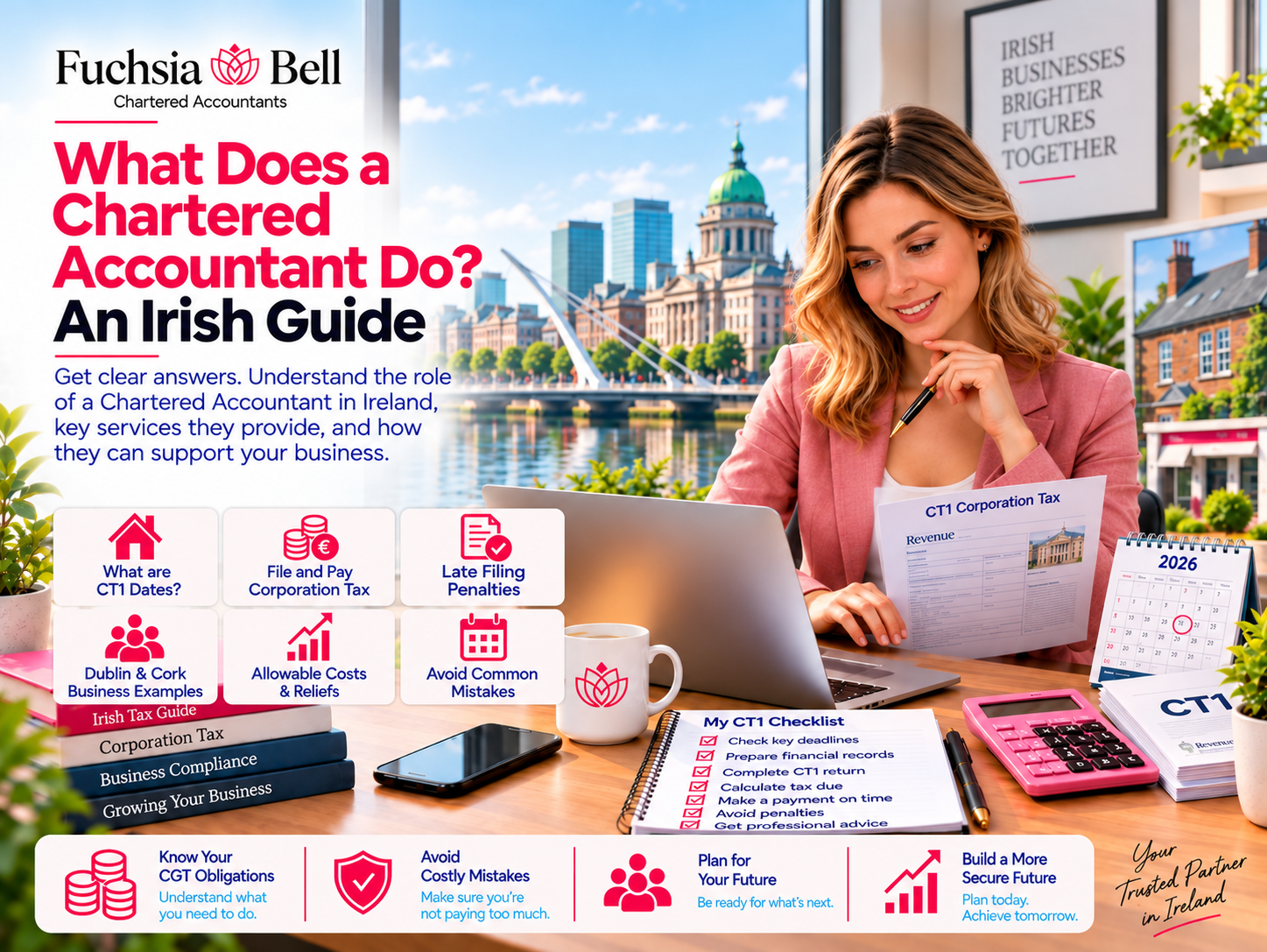
A chartered accountant is a qualified, regulated accounting professional who has trained and passed the exams of a chartered accountancy body. In Ireland that usually means Chartered Accountants Ireland. In practice, a chartered accountant prepares financial statements, files tax returns, advises on tax and business decisions and, if registered as an auditor, carries out statutory audits. This guide explains what the qualification means, how it differs from other accounting titles in Ireland, and how to check who you are hiring.
What makes an accountant “chartered” in Ireland?
To become a member of Chartered Accountants Ireland, a person completes the ACA qualification. That means passing a series of professional exams in financial reporting, tax, audit, law and business strategy, while completing a period of supervised practical training with an approved employer. Members then use the letters ACA after their name.
Experienced members can be admitted as Fellows, using the letters FCA. Fellowship is awarded by the Institute in recognition of a member’s experience and contribution to the profession.
Membership is not a one-off achievement. Chartered accountants must:
- complete continuing professional development every year to keep their knowledge current;
- follow the Institute’s code of ethics;
- hold a practising certificate and professional indemnity insurance if they offer services to the public;
- accept the oversight of the Chartered Accountants Regulatory Board (CARB), which operates independently within the Institute and handles monitoring, complaints and discipline.
Since 1 September 2024, CPA Ireland has been amalgamated into Chartered Accountants Ireland, so former CPA members now operate under the same institute.
If you are interested in the career rather than hiring one, our guide on how to become a chartered accountant in Ireland covers the training routes and exams.
What does a chartered accountant do for clients?
A chartered accountant in practice works across four broad areas. Smaller firms tend to cover all four for the same client, which is one of the main advantages of working with one.
Compliance
Annual financial statements, corporation tax returns (CT1), income tax returns (Form 11), VAT returns, payroll and CRO annual returns, all filed on time.
Tax advice
Choosing between sole trader and company status, planning salary and dividends, capital gains tax on property and shares, and inheritance planning.
Business advice
Cash flow forecasts, pricing and profitability reviews, funding applications and acting as an outsourced finance director for growing businesses.
Assurance
Statutory audits and other assurance work, which only accountants registered as statutory auditors can sign.
The real value is that these areas connect. The figures in your accounts drive your tax bill, your tax position shapes your business decisions, and a chartered accountant is trained to see all three together rather than one return at a time.
Chartered accountant vs other accounting titles in Ireland
Here is something many people do not realise: in Ireland, the word “accountant” on its own is not legally protected. Anyone can use it, whatever their training. A bill introduced in the Dáil in 2025, the Companies (Protection of Title: Accountant) Bill, proposes to restrict the title to members of recognised bodies, but until any such law is passed the protection comes from checking credentials yourself.
The Irish Auditing and Accounting Supervisory Authority (IAASA) supervises five prescribed accountancy bodies in Ireland: ACCA, AIA, Chartered Accountants Ireland, CIMA and CIPFA. Members of these bodies are qualified, regulated, monitored and, in practice, insured.
| Title | Designation | Typical focus |
|---|---|---|
| Chartered accountant | ACA or FCA (Chartered Accountants Ireland) | Practice and business: reporting, tax, audit, advice |
| Chartered certified accountant | ACCA or FCCA (ACCA) | Practice and business, with a strong international base |
| Chartered management accountant | ACMA or FCMA (CIMA) | Mainly in industry: costing, budgeting, performance |
| Chartered tax adviser | CTA (Irish Tax Institute) | Specialist tax advice |
| Accounting technician | MIATI (Accounting Technicians Ireland) | Bookkeeping, payroll and accounts support |
| Bookkeeper | No required qualification | Recording day-to-day transactions |
Each of these roles has a place. A bookkeeper can keep your records accurately and affordably. A chartered tax adviser may be the right person for a complex inheritance. The point is to know which you are hiring and match it to the job.
When do you actually need a chartered accountant?
Strictly, you need a registered statutory auditor only when your company requires an audit. In Ireland, auditors are approved by the two recognised accountancy bodies, Chartered Accountants Ireland and ACCA.
Beyond that, a chartered accountant is the stronger choice when:
- you run a limited company and want accounts, tax and company law handled together;
- you are selling property, shares or a business and capital gains tax is involved;
- you have income from several sources or from abroad;
- a bank, investor or grant body will rely on your accounts;
- you want advice on growth and profitability, not just filings;
- Revenue has opened a query or compliance check.
A common worry is that a chartered accountant must be expensive. Fees depend on the work involved far more than on the letters after someone’s name, and many chartered firms now offer fixed monthly pricing. Our guide to accountant costs in Ireland explains what really drives the fee.
How to check an accountant’s credentials
- Ask for the designation. A qualified accountant will tell you their body and letters, such as ACA, FCA, ACCA or FCCA, without hesitation.
- Check the membership directory. IAASA recommends confirming membership directly with the professional body or through its online directory.
- Ask about the practising certificate. Members who offer services to the public should hold one.
- Confirm professional indemnity insurance. It protects you if something goes wrong.
- Get an engagement letter. It should name the person responsible for your work and list every service included.
Online chartered accountant or local office?
Ten years ago, choosing an accountant meant choosing someone nearby. Today, Revenue, the CRO and most accounting software all work online, so the location of your accountant matters far less than their qualification and responsiveness.
An online chartered accountant can serve a tech start-up in Dublin and a guesthouse in Dingle in exactly the same way: secure document upload, cloud bookkeeping, video meetings and filings made directly on ROS and CORE. Many clients prefer it because it saves travel and gives them access to their figures at any time.
Local knowledge still has value. Businesses in tourism, farming and hospitality in Kerry, for example, have seasonal cash flows and sector-specific tax rules, while Dublin businesses often deal with higher staff costs, remote workers and investors. A good firm understands both. Fuchsia Bell is based in Co. Kerry and works online with clients across Ireland, including through our chartered accountant services in Dublin and our chartered accountants in Kerry.
Questions to ask before you hire
- Which professional body are you a member of, and do you hold a practising certificate?
- Who will actually prepare and review my returns?
- Is your fee fixed, and what exactly does it include?
- How quickly do you reply to emails and calls?
- Which accounting software do you work with?
- Do you have experience with businesses in my sector?
- How will you remind me of deadlines and documents you need?
About the author
This guide was written by Ger O’Connor FCA, founder of Fuchsia Bell and a Fellow of Chartered Accountants Ireland. Ger holds a Commerce degree from the University of Galway and has worked in practice, in industry and as the owner of several businesses. You can read more about Ger and the team on our about Fuchsia Bell page.
Talk to a Fellow Chartered Accountant
Book a free 30-minute business check with Fuchsia Bell. You will get clear advice and a fixed fee before any work starts, wherever you are in Ireland.
Questions About Chartered Accountants
What does a chartered accountant do?
A chartered accountant prepares financial statements, files tax returns, gives tax and business advice and, if registered as a statutory auditor, carries out audits. They are qualified and regulated by a chartered accountancy body, in Ireland usually Chartered Accountants Ireland.
What is the difference between a chartered accountant and an accountant?
In Ireland, anyone can call themselves an accountant because the title is not legally protected. A chartered accountant has passed the exams and training of a chartered body and is subject to ongoing regulation, professional development and ethical rules.
What do the letters ACA and FCA mean?
ACA means Associate Chartered Accountant, the designation used by qualified members of Chartered Accountants Ireland. FCA means Fellow Chartered Accountant, awarded by the Institute to experienced members.
Is a chartered certified accountant the same as a chartered accountant?
No. A chartered certified accountant is a member of ACCA, while a chartered accountant in Ireland is a member of Chartered Accountants Ireland. Both are prescribed accountancy bodies supervised by IAASA, and both can approve members as statutory auditors.
Do I need a chartered accountant for my small business?
Not by law, unless your company requires an audit. Many small businesses choose one because they want qualified, insured advice that covers accounts, tax and company law together.
Can a chartered accountant work with me online?
Yes. Most compliance work in Ireland is filed online through ROS and the CRO’s CORE system, so a chartered accountant can look after clients anywhere in the country without meeting in person.
Information checked against IAASA, Chartered Accountants Ireland and Oireachtas sources in November 2026.