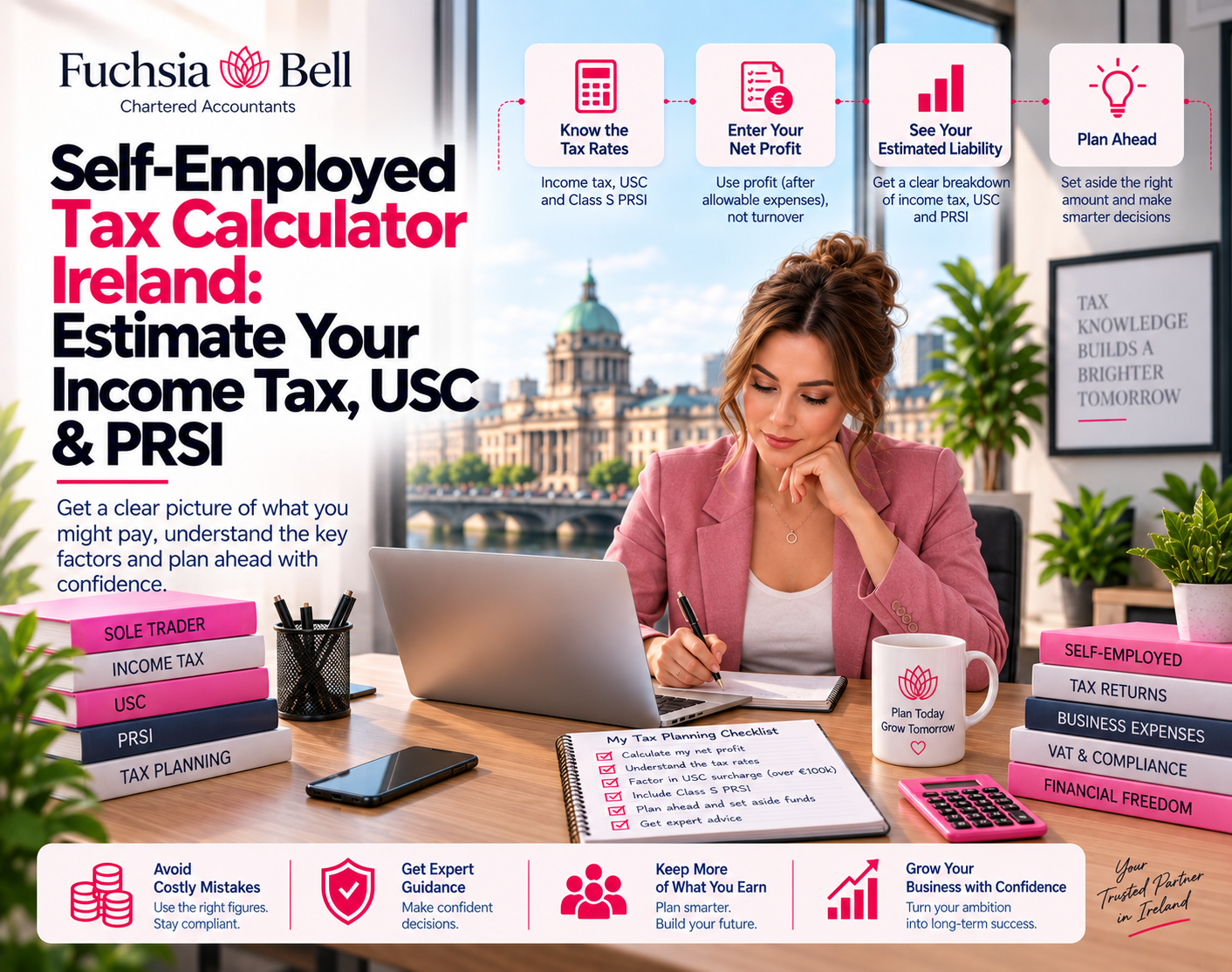
Self-employed profit in Ireland is taxed at 20% or 40% income tax, USC from 0.5% up to 8%, and Class S PRSI at 4.2%, the same headline structure a PAYE employee faces. The difference that actually changes the final bill sits in two places a generic calculator often misses: there’s no PAYE credit for self-employed income, and profit above €100,000 carries a USC surcharge PAYE workers never pay at all.
Everything below assumes profit, income after allowable business expenses, not turnover. Calculating tax on turnover rather than profit is the single most common input error self-employed people make when using any calculator, generic or otherwise.
The Three Charges on Self-Employed Profit
Income tax runs at 20% on profit up to €44,000 for a single person, then 40% above that, calculated before credits are applied. USC follows the same bands as PAYE workers: 0.5% up to €12,012, 2% to €28,700, 3% to €70,044, and 8% above that. Class S PRSI, the self-employed category, is 4.2% of net profit, with a minimum annual contribution of €650 even in a low-profit year. Declaring all of this correctly runs through the same income tax return process as any other self-assessed filing.
Working Through an Actual Profit Figure
A sole trader with €60,000 in net profit for the year has €44,000 taxed at 20% and €16,000 taxed at 40%, giving €15,200 in gross income tax before credits.
| Item | Amount |
| Net profit | €60,000 |
| Income tax (after €4,000 credits) | €11,200 |
| USC | ≈ €1,333 |
| Class S PRSI (4.2%) | €2,520 |
| Approximate net income | €44,947 |
The €4,000 in credits comes from the Personal Tax Credit and the Earned Income Credit, both €2,000 each for 2026. Getting the estimate this close to the real figure matters most when deciding how much to set aside monthly, rather than discovering the actual liability only when the tax services bill for the year gets calculated in October.
The Surcharge That Doesn’t Apply to PAYE Workers
Self-employed profit above €100,000 carries an additional 3% USC surcharge on the portion above that threshold, on top of the standard 8% rate already applying there. That brings the effective USC rate on high self-employed earnings to 11%, a full three points higher than a PAYE employee pays on the exact same income level. This surcharge exists specifically to bring high-earning self-employed taxpayers closer to what an equivalent PAYE earner contributes overall, and it’s the single biggest reason a generic take-home pay calculator, built around PAYE assumptions, understates tax for a self-employed person once profit crosses six figures. A broader look at how this surcharge factors into structuring decisions for higher-earning sole traders is covered on geroconnor.info.
Why Self-Employed and PAYE Credits Finally Match
Self-employed taxpayers don’t receive the PAYE Tax Credit at all. Instead, they claim the Earned Income Credit, which has matched the PAYE credit at €2,000 each since Budget 2024 narrowed a gap that used to exist between the two. Before that alignment, a self-employed person paid noticeably more income tax than a PAYE employee on identical income, purely through the credit structure rather than the tax rates themselves. Filing the correct tax returns claim for this credit is automatic through Form 11 rather than something that needs separately requesting.
Class S PRSI Covers Less Than the Rate Suggests
Paying 4.2% under Class S doesn’t buy access to the same range of social welfare entitlements as Class A PRSI, which most PAYE employees pay. Illness Benefit and Jobseeker’s Benefit, both available to Class A contributors, generally aren’t available under Class S, even though the contribution rate looks broadly comparable on paper. This matters most for a consultants practice or freelancer relying entirely on self-employed income with no PAYE employment alongside it, since the safety net looks thinner than the PRSI percentage alone would suggest.
When Sole Trader Profit Starts Favouring a Limited Company
Below roughly €80,000 in profit, the tax difference between operating as a sole trader and running the same activity through a limited company is generally small enough that incorporation costs, accountancy fees, payroll administration, and director compliance obligations, outweigh the tax benefit. Above that level, retained profit inside a company taxed at 12.5% corporation tax starts to look more efficient than the same profit taxed at a personal 40% rate, with the actual break-even point typically falling somewhere between €80,000 and €120,000 depending on how much needs to be drawn as salary.
What Incorporating Actually Changes Day to Day
Moving from sole trader to limited company isn’t just a tax decision. It adds CRO filings, a separate business bank account, formal payroll for any salary drawn, and annual accounts that didn’t exist as a self-employed sole trader. Working through the practical side of this alongside the tax comparison, as part of proper start-up planning, avoids incorporating purely for a tax saving that gets partly offset by new compliance costs nobody budgeted for.
Frequently Asked Questions
Does the 3% USC surcharge apply to PAYE income if I also have a job?
No. The surcharge applies only to self-employed or non-PAYE income above €100,000. PAYE income from separate employment isn’t affected by it, even where combined income exceeds the threshold.
Can pension contributions reduce Class S PRSI as well as income tax?
No. Pension contributions reduce income subject to income tax, but USC and Class S PRSI are both calculated on profit before any pension deduction.
Is there a minimum PRSI payment even in a loss-making year?
Generally yes, a minimum annual Class S contribution of €650 applies once self-employed income exists, regardless of how low the actual profit was for the year.
Do allowable expenses reduce USC and PRSI the same way they reduce income tax?
Yes. Unlike a pension contribution, genuine allowable business expenses reduce the profit figure used for all three calculations, income tax, USC, and PRSI, since they’re deducted before net profit is arrived at.
Does becoming VAT registered change any of these calculations?
No. VAT is a separate tax charged on top of sales and reclaimed on purchases, and it doesn’t factor into the income tax, USC, or PRSI calculation on business profit itself.
Getting a Figure That Actually Holds Up in October
A rough estimate is useful for monthly planning. What actually needs to be accurate is the preliminary tax figure paid alongside the annual return, since underestimating it carries interest from the original due date rather than from whenever the shortfall gets noticed. A fuller picture of how online chartered accountants work with sole traders and freelancers on both the calculation and the filing is covered on geroconnor.info as well.