Quick answer
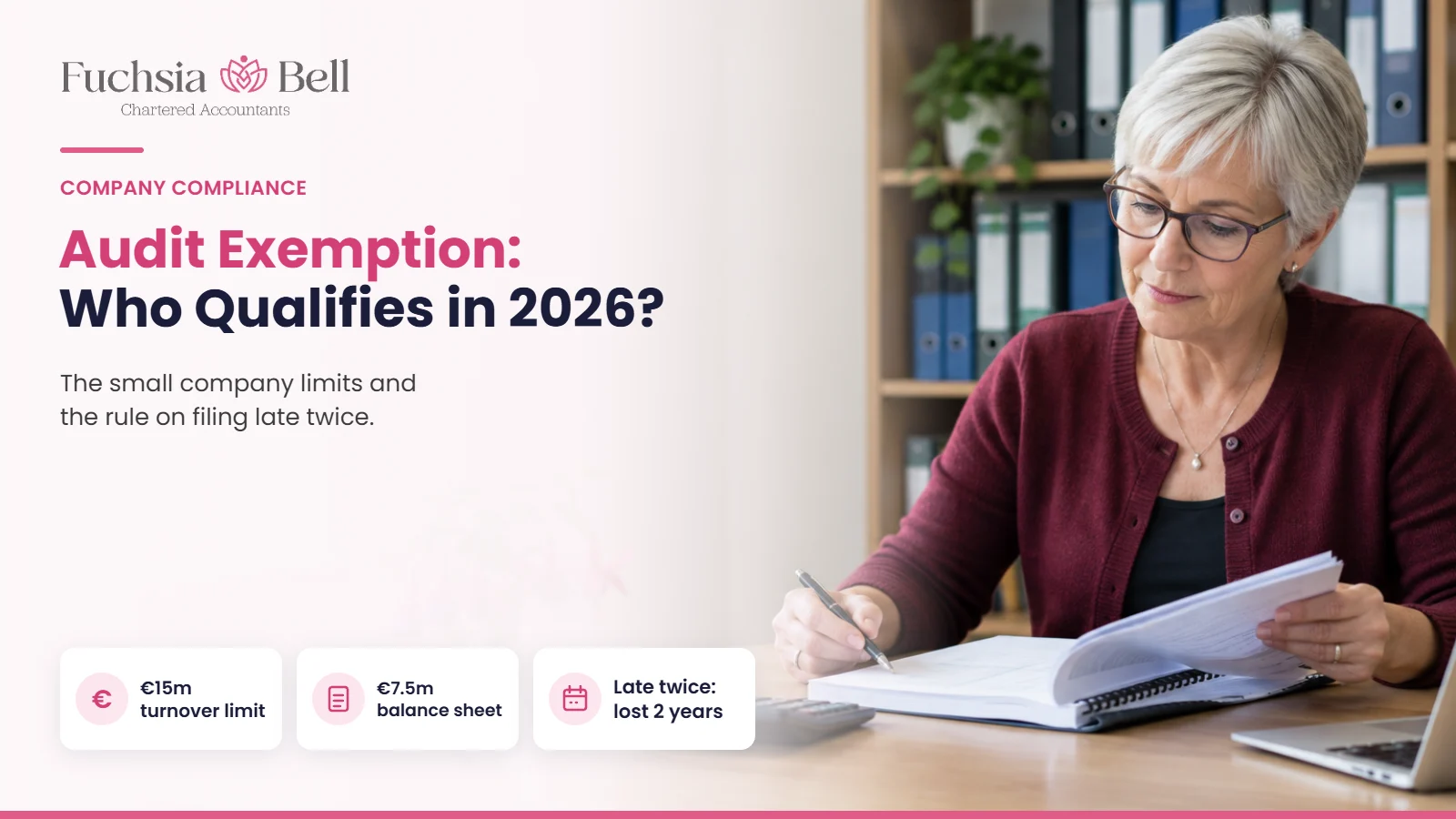
Most private companies in Ireland don’t need an audit. A company can claim the audit exemption if it qualifies as small: it meets two of three limits, turnover of €15 million or less, a balance sheet total of €7.5 million or less and 50 or fewer employees, for the current and previous year. It also mustn’t be an excluded type of company, and no shareholder with 10% or more of the votes can have asked for an audit. Since 16 July 2025, a company only loses the exemption if it files its annual return late more than once in five years. It then loses it for the following two years.
Key takeaways
- The small company limits rose in 2024, to €15m turnover, €7.5m balance sheet and 50 employees. You must meet two of the three.
- The higher limits apply to financial years beginning on or after 1 January 2024, and companies could choose to apply them from 1 January 2023.
- Filing your annual return late once in five years no longer costs you the exemption. Filing late twice does, for two years.
- Shareholders with 10% or more of the voting rights can insist on an audit.
- Dormant companies of any size can use a separate dormant company exemption.
What is the audit exemption?
The Companies Act 2014 requires a company’s financial statements to be audited unless an exemption applies. The small company audit exemption lets most owner-managed companies skip the audit. They still prepare full financial statements, file them with their annual return (Form B1) and file their tax returns.
An audit can cost much more than unaudited accounts, so keeping the exemption is worth real money for a small company. It doesn’t change the need for good records. Directors are still responsible for accurate accounts, and Revenue, banks and grant bodies still rely on them.
The size limits since 2024
Company size is decided by two of three tests, met in the current financial year and the one before. In a company’s first financial year, only that year counts. The limits rose with S.I. No. 301/2024, in line with an EU directive that adjusted them for inflation.
| Size | Turnover | Balance sheet total | Average employees |
|---|---|---|---|
| Micro (new limits) | €900,000 or less | €450,000 or less | 10 or fewer |
| Micro (old limits) | €700,000 | €350,000 | 10 |
| Small (new limits) | €15 million or less | €7.5 million or less | 50 or fewer |
| Small (old limits) | €12 million | €6 million | 50 |
The new limits apply to financial years beginning on or after 1 January 2024. Companies were also allowed to apply them to financial years beginning on or after 1 January 2023. For groups, the whole group must qualify as small. The same €15 million and €7.5 million limits apply, calculated net of transactions within the group.
The four conditions for the small company audit exemption
The CRO sets out the conditions:
- The company qualifies as small under the size tests above.
- It isn’t an excluded type. Public limited companies, public unlimited companies, investment companies, credit institutions, insurance undertakings and companies listed in the Fifth Schedule to the Companies Act 2014 can’t claim it.
- Its annual return, with financial statements, is filed on time. The late-filing rule below explains what happens if it isn’t.
- No shareholder has served a notice requiring an audit. Members holding 10% or more of the voting rights (or one member of a company limited by guarantee) can serve a written notice under section 334. It must be served in the previous financial year, or no later than one month before the end of the financial year in question.
If the company stops meeting the conditions during a year it planned to claim the exemption for, the directors must appoint an auditor as soon as possible.
The late-filing rule since July 2025
For years, a single late annual return cost a small company its audit exemption for two years. That changed on 16 July 2025, when section 22 of the Companies (Corporate Governance, Enforcement and Regulatory Provisions) Act 2024 came into force.
Now a company loses the exemption only if its annual return is filed late in the year it claims the exemption and late on another occasion in the previous five years. When that happens, it can’t claim the exemption for the following two years. Late returns filed before the change took effect, and a company’s first annual return, don’t count as earlier failures.
The late filing fee still applies every time. Our guide to the CRO annual return (Form B1) covers deadlines and fees. Ger O’Connor explains the wider fallout in what happens if you don’t file your annual return, up to and including strike-off.
An example. A Kerry joinery company has turnover of €2.8 million, a balance sheet of €1.1 million and 14 staff, comfortably small. It files its 2026 annual return a week late. It pays the late fee but keeps its exemption. If it then files late again in 2029, within five years of the first, it loses the exemption for the following two years and needs audited accounts for both.
Dormant companies and abridged accounts
Dormant companies. A company of any size can claim a separate dormant company exemption if it had no significant accounting transactions in the year. Its assets and liabilities can only be shares in, and amounts owed to or from, other group companies. The directors must decide to use the exemption and record that in their minutes. The members’ right to require an audit doesn’t apply to dormant companies.
Abridged accounts. Small and micro companies can also file abridged financial statements with the CRO, which means a shorter version that keeps more of their figures private. That’s a separate exemption from the audit exemption, but it uses the same size tests.
Common mistakes
| Mistake | Why it matters |
|---|---|
| Checking size against one year only | Small status depends on the current and the previous year. |
| Ignoring the group | A subsidiary can’t claim on its own size if the group isn’t small. |
| Leaving filing to the last day | A second late filing within five years costs the exemption for two years. Our online annual accounts and CT returns service is built around the deadlines. |
| Forgetting the 10% shareholder right | A minority shareholder can require an audit, so check your shareholders’ agreement. |
| Treating “exempt” as “no accounts” | You still need full financial statements for the B1 and your CT1 return. |
Official sources
- CRO: Exemptions available in relation to financial statements
- CRO: Requirements for audit exemption
- Irish Statute Book: S.I. No. 301/2024, adjustments of size criteria
- Chartered Accountants Ireland: Company law thresholds
Want to keep your audit exemption?
We prepare your annual accounts, file your B1 and CT1 on time and keep track of every deadline for you.
Questions about audit exemption
What are the audit exemption thresholds in Ireland?
A company is small if it meets two of these three: turnover of €15 million or less, a balance sheet total of €7.5 million or less and 50 or fewer employees, in the current and previous financial year. Micro companies have lower limits of €900,000, €450,000 and 10 employees.
Do I lose audit exemption if I file my annual return late?
Not for a first late filing within five years. Since 16 July 2025, you only lose it if you file late in the year you claim the exemption and also filed late once before in the previous five years. You then lose it for the following two years.
Can a shareholder force a company to have an audit?
Yes. Members holding at least 10% of the voting rights can serve a notice under section 334 requiring an audit, within set time limits.
Does a dormant company need an audit?
Usually not. A dormant company of any size can claim the dormant company exemption if it had no significant accounting transactions and the directors record their decision.
Do audit-exempt companies still need accounts?
Yes. They prepare full financial statements, file them with the CRO annual return and use them for their corporation tax return. Only the audit is skipped.
Keep the exemption by filing on time
For most small companies, the audit exemption is simply about staying small and filing on time. The 2024 thresholds brought more companies into the small category, and the 2025 change gives one second chance. Treat the annual return date as fixed, keep an eye on your size as you grow, and the exemption should stay in place. Directors who let filings lapse altogether face bigger problems, which Ger covers in directors struck off by the CRO.