Quick answer
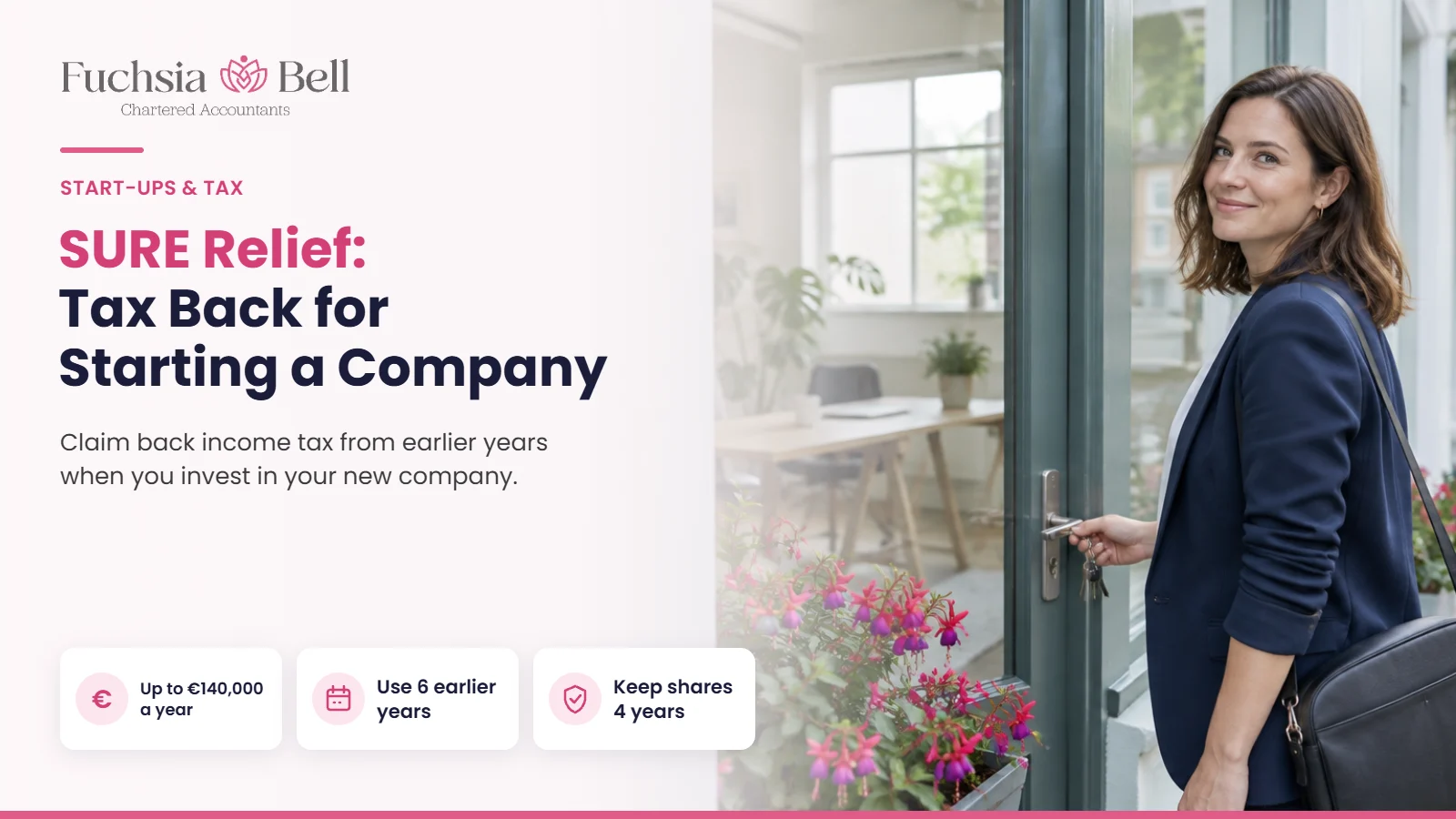
Start-Up Relief for Entrepreneurs (SURE) gives you back income tax you paid as an employee when you put your own cash into a new company and go to work in it full time. You can set the investment against your income in the year you invest and up to six earlier years, up to €140,000 of relief a year. The company must be new, trading and an SME. You need to have had mainly PAYE income, hold at least 15% of the shares and keep them for four years. Budget 2027 extended SURE beyond 2026, subject to EU state aid approval.
Key takeaways
- SURE is a refund of income tax you’ve already paid. It doesn’t refund USC or PRSI.
- The investment must be cash, used to buy new shares in a new company that carries on a new trade.
- Relief of up to €140,000 a year applies to investments made from 1 January 2025. The earlier limit was €100,000.
- You can spread the relief over the year of investment and up to six earlier years.
- You must work full time in the company for 12 months and keep the shares for at least four years.
How does SURE work?
SURE treats the money you invest in your new company as a deduction from your income in earlier years. Revenue then recalculates those years and refunds the income tax you overpaid.
Suppose you spent years on PAYE paying tax at 40%. Each euro of relief set against that top slice of income gives you back 40 cent. In practice, SURE gives you back much of the tax you paid as an employee, at the point your new business needs cash most.
You choose which years to use, so you can target the years in which you paid the most tax at the higher rate.
Who qualifies for SURE?
Revenue says you can claim if you’re starting your own business and you’re an employee, unemployed or recently made redundant. The detailed conditions are in Revenue’s Tax and Duty Manual for SURE.
| Condition | What it means |
|---|---|
| Mainly PAYE income | In each of the three years before the year just before you invest, your non-employment income can’t exceed the lower of your employment income or €50,000. The year just before and the year you invest have no limit. |
| Cash for new shares | You subscribe cash for new ordinary shares. A minimum €250 investment applies. |
| At least 15% of the company | You must hold at least 15% of the issued ordinary share capital for one year from the share issue, or from when trading starts if later. |
| Full-time role | You work full time as an employee or director for 12 months. You can hold other work of up to 10 hours a week. |
| Hold for four years | You must keep the shares for at least four years from issue. |
| Timing | The first investment must be within two years of the end of the year the company was incorporated. A second can follow in either of the next two years. |
For a 2026 investment, the “mainly PAYE” test looks at 2022, 2023 and 2024.
What kind of company qualifies?
The company has to meet its own conditions:
- It’s incorporated in Ireland, the EEA or the UK, is tax resident there and trades from a fixed place of business in Ireland.
- It has a tax clearance certificate. Our guide to tax clearance certificates explains how to get one.
- It’s an unquoted SME and not an undertaking in difficulty.
- It carries on a qualifying new venture: a trade that wasn’t previously carried on by anyone else, including you as a sole trader.
That last point catches many people. If you already run the business as a sole trader, moving it into a company doesn’t create a new venture, so SURE won’t apply. If you’re still deciding on a structure, read sole trader vs limited company first. Some trading activities are also excluded, so check yours before you invest. A new company may also get up to five years of corporation tax relief, which Ger explains in start-up corporation tax relief.
Worked example: an engineer starts her own company
Ciara earned €70,000 a year as a PAYE engineer. In 2026 she leaves her job, sets up a new engineering services company, takes up a full-time director role and buys €60,000 of new shares in cash. Her income was almost all PAYE, so she passes the income test. As a single person, the top slice of her income each year was taxed at 40%.
She sets the €60,000 against the 40% slices of her three most recent full years:
| Year | 20% band (single) | Income taxed at 40% | Relief used | Income tax refunded |
|---|---|---|---|---|
| 2025 | €44,000 | €26,000 | €26,000 | €10,400 |
| 2024 | €42,000 | €28,000 | €28,000 | €11,200 |
| 2023 | €40,000 | €30,000 | €6,000 | €2,400 |
| Total | €60,000 | €24,000 |
Ciara gets back €24,000, which is 40% of her investment, using only three of the seven years available. If she had set all €60,000 against 2025 alone, much of it would have hit income taxed at 20%. Her refund would then have been capped at the €15,200 income tax she actually paid that year, after her personal and employee tax credits.
The example assumes the same salary each year and no other income or reliefs. Your figures will differ, and your accountant should model them before you choose the years.
How do you claim SURE?
There are two stages, one for the company and one for you.
- The company files a RICT return on ROS within four months of the end of the tax year in which the shares were issued. For shares issued in 2026, that means by 30 April 2027.
- The return produces a Statement of Qualification (SOQSURE). The company must give it to you by 31 December of the year after the share issue.
- You claim the relief on your income tax return (Form 11 or Form 12) through ROS, using the SOQSURE. Where ROS can’t process every year you’re claiming for, you send the statement to your Revenue office.
The usual four-year time limit for tax refunds doesn’t apply to SURE claims, which helps when you’re reaching back several years.
What can go wrong?
| Mistake | Why it matters |
|---|---|
| Incorporating an existing sole trade | It isn’t a new venture, so SURE isn’t available. |
| Lending the money instead of buying shares | Only cash subscribed for new ordinary shares qualifies. |
| Holding under 15% | You must hold at least 15% for the first year. Plan the shareholdings before you invest. |
| Keeping your old job | You can only work up to 10 hours a week elsewhere while meeting the full-time condition. |
| Selling shares within four years | Breaking the holding period can lead to the relief being withdrawn. |
| Leaving it too late | The first investment must be made within two years of the end of the year of incorporation. |
Official sources
- Revenue: Start-Up Relief for Entrepreneurs (SURE)
- Revenue: Tax and Duty Manual Part 16-00-05, Start-Up Relief for Entrepreneurs
- KPMG Ireland: Budget 2027 headlines (extension of SURE)
Leaving your job to start a company?
We'll check whether you qualify for SURE, set up the company and shares correctly and file the claim for you.
Questions about SURE relief
What is SURE relief in Ireland?
SURE (Start-Up Relief for Entrepreneurs) refunds income tax you paid in earlier years when you invest cash in new shares of a new company and work in it full time. You can claim up to €140,000 of relief a year for investments from 2025.
How many years back can SURE go?
You can set the investment against your income in the year you invest and up to six earlier years, seven years in total. The normal four-year limit on refunds doesn’t apply.
Can I claim SURE if I'm already a sole trader?
Usually not for that business. The company must carry on a new venture that wasn’t previously carried on by anyone, including you as a sole trader.
Does SURE refund USC and PRSI?
No. SURE gives relief from income tax only. USC and PRSI you paid aren’t refunded.
Is SURE still available after 2026?
Budget 2027 announced that SURE will be extended, subject to the new EU General Block Exemption Regulation being adopted. Check the position before you invest.
Plan the investment before you set up
SURE rewards people who plan. The share structure, the timing of the investment, your start date and the choice of years all affect how much you get back. Make those decisions before you incorporate, not after, and you could start your company with a significant share of your past tax back in the bank. Once you’re trading, Ger O’Connor’s guide to your first 90 days as a new business owner covers what to set up next.