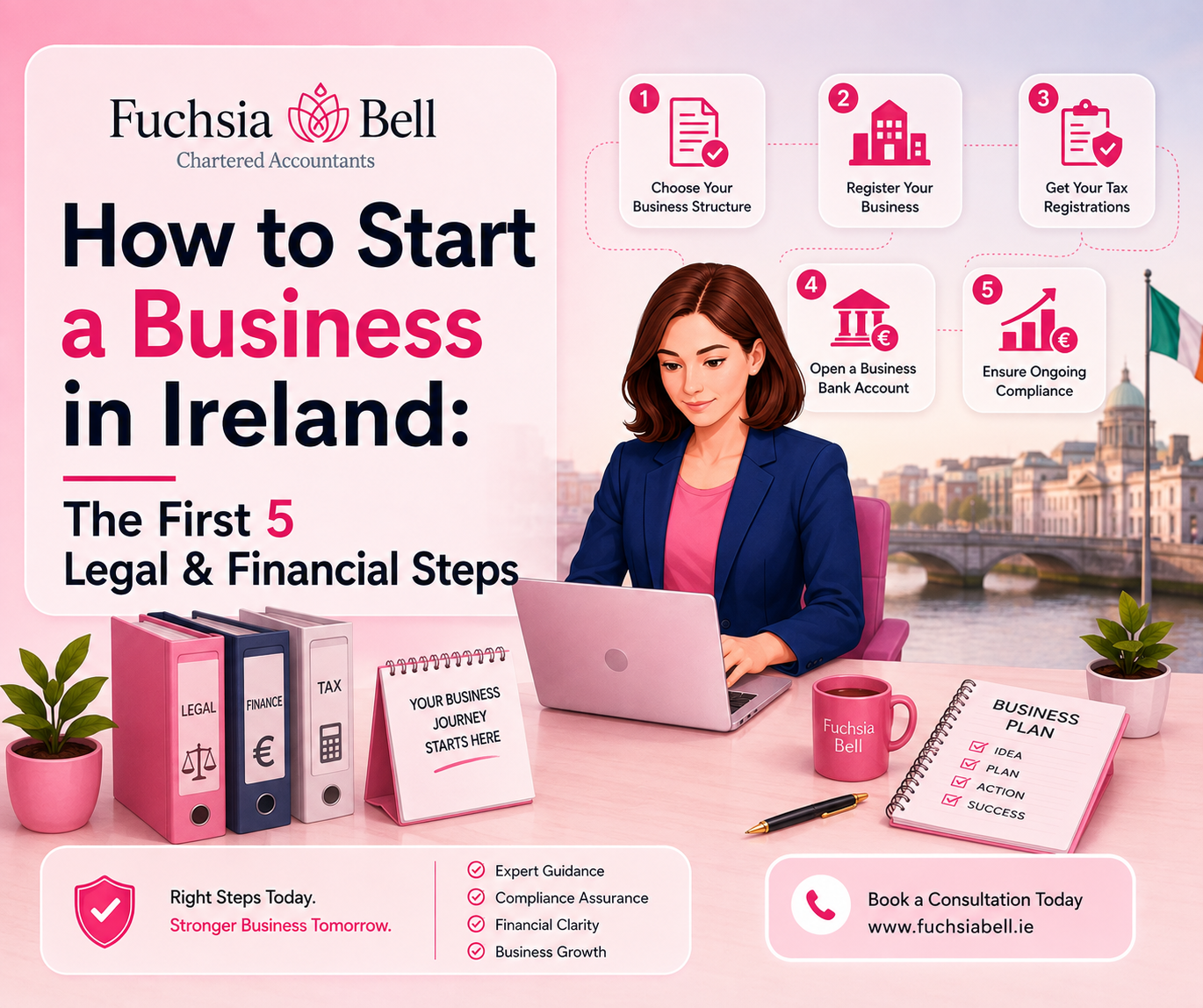
Most people who decide to start a business in Ireland get the idea right. It’s the paperwork that trips them up. Revenue deadlines, CRO filings, VAT thresholds, company secretarial obligations it’s a lot to absorb before you’ve even landed your first client. The good news is that the legal and financial setup process is entirely predictable. There are five steps. They have a clear order. And getting them right from the beginning saves you considerable trouble later.
Here’s what every new start-up in Ireland actually needs to do first.
At a Glance: The 5 Steps and Who You Deal With
Before the detail, here’s the full sequence so you can see how each step feeds into the next:
| Step | What You’re Doing | Who You Deal With |
|---|---|---|
| 1 | Choose your business structure | Your accountant or legal advisor |
| 2 | Register your company with the CRO | Companies Registration Office (CRO) |
| 3 | Register for tax with Revenue | Revenue Commissioners |
| 4 | Assess your VAT obligations | Revenue Commissioners |
| 5 | Set up bookkeeping, payroll & company secretarial | Your accountant and the CRO |
Steps 1 and 2 happen once. Steps 3 through 5 are ongoing – the systems you put in place at launch are the ones your business grows inside. Get them right early and compliance becomes background noise rather than a recurring crisis.
Step 1: Choose the Right Business Structure
This first decision shapes everything else – your tax position, your personal financial exposure, and how your business appears to clients and potential investors. In Ireland, most start-ups sit at the fork between two structures: sole trader or private limited company (LTD).
Operating as a sole trader is faster and involves less paperwork. There’s no CRO registration, no annual returns. The trade-off is that your business and your personal finances are legally the same entity. If the business owes money, you owe it personally. For early-stage sole traders with modest turnover and no staff, this is manageable – but it carries real risk as revenue grows.
A private limited company (LTD) keeps your personal assets separate from the business. You are a shareholder and usually a director. The company pays Corporation Tax on its profits; you pay income tax on whatever salary or dividends you draw. This is the structure most Irish start-ups incorporate as, particularly once they’re dealing with clients regularly, hiring people, or generating revenue that justifies proper protection.
The right answer depends on your revenue trajectory, whether you’re hiring, and how you want to be seen by customers. A chartered accountant can walk through the numbers with you in half an hour and give a clear recommendation based on your actual situation. Our start-up accounting support is built specifically for founders working through exactly this decision.
Step 2: Register Your Company with the Companies Registration Office (CRO)
Once you’ve decided on a limited company, registration is next. The Companies Registration Office (CRO) maintains Ireland’s official register of companies. You register using Form A1, which requires the following:
- A proposed company name — it must be unique, not misleading, and not too similar to an existing registered name
- A registered office address in Ireland (this is a legal address, not necessarily where you operate)
- Details of at least one director — at least one must be an EEA resident, or a bond must be in place
- Company secretary details (this role is mandatory for every Irish company)
- The company’s share capital structure
- A copy of the company’s constitution
The CRO typically processes a standard Form A1 within three to five working days. You receive a Certificate of Incorporation and a unique CRO number – that number stays with your company permanently and appears on all official documents.
One thing that catches first-time founders off-guard: the company secretary role isn’t optional or informal. Every Irish company must have a named company secretary who is legally responsible for ensuring statutory filings are made correctly and on time. For most small start-ups, their accountant fills this role. Our company secretarial services in Ireland cover this from incorporation right through to your ongoing CRO obligations.
Step 3: Register for Tax with Revenue
Your company must register with Revenue Commissioners within 30 days of commencing trade. You register online via ROS (Revenue Online Service) using Form TR2, and Revenue assigns your company a Tax Reference Number – sometimes called a PPSN equivalent for companies.
For limited companies, the primary tax on profits is Corporation Tax. Ireland’s standard Corporation Tax rate on trading income is 12.5% — one of the lowest in the EU and a significant part of why Ireland attracts start-ups and international companies alike. (A 15% rate applies only to very large multinationals with global turnover exceeding €750 million, introduced under the OECD Pillar Two rules – not something most start-ups will encounter.)
Your Corporation Tax return (Form CT1) is due within nine months of your accounting year-end. Missing that deadline triggers automatic surcharges. Build it into your calendar on day one rather than finding out about it when Revenue writes to you. Our Corporation Tax service ensures returns are filed accurately and submitted before the deadline — without the last-minute scramble that catches too many start-ups out in year two.
One more point here: if you’re paying yourself a director’s salary, you need to run PAYE through payroll — even for your own pay. This is genuinely news to many first-time directors, and Revenue does follow up on it.
Step 4: Understand Your VAT Obligations
Not every start-up needs to register for VAT immediately. But you need to understand the thresholds early, because crossing them without registering creates a penalty and interest situation that’s expensive and avoidable.
In Ireland, VAT registration is compulsory once your annual turnover exceeds:
- €37,500 for the supply of services
- €75,000 for the supply of goods
(These thresholds are set by Revenue and can change – always confirm the current figures at Revenue.ie or with your accountant before making decisions based on them.)
Voluntary VAT registration — before you hit the threshold – is often worth considering. If your clients are other VAT-registered businesses, being VAT-registered means you can reclaim VAT on your own purchases. It also signals to some clients that your business is established and trading at scale. The decision depends on your client base and margins.
Once registered, you’ll file VAT3 returns bi-monthly or annually depending on Revenue’s assigned filing frequency. Late or incorrect VAT3 returns attract surcharges and interest. Our team handles VAT registration and ongoing compliance for start-ups across Ireland — from the initial registration application through to preparing and submitting returns on your behalf.
Get Your Free Start-Up Quote →
Step 5: Set Up Your Financial Systems – Bookkeeping, Payroll & Company Secretarial
The first four steps get your company legally registered and compliant. This one keeps it that way as you operate. Three systems matter most from the start, and the cost of getting them wrong compounds over time.
Bookkeeping
Every Irish company is legally required to maintain proper books and records. In practice, this means recording every income and expense accurately so your accounts are correct when tax time arrives — and so you actually know where your business stands at any point. Doing it in real time, rather than as a frantic catch-up before the filing deadline, makes everything downstream simpler and cheaper. Our online bookkeeping service uses AutoEntry to automate invoice capture and Sage Cloud Accounts for real-time reporting, so your financial picture is always current — and always accessible from wherever you’re working.
Payroll
If you’re paying employees — or yourself as a director — you need a payroll system that handles PAYE, PRSI, and USC correctly and reports to Revenue in real time under the PAYE Modernisation system introduced in 2019. Getting payroll wrong creates Revenue compliance problems that are genuinely difficult to unwind after the fact. Our payroll services for Irish businesses cover everything from employee payslips to director pay calculations and Revenue reporting, on a weekly, fortnightly, or monthly basis — whichever suits your business.
Company Secretarial & Annual Compliance
Once incorporated, your company carries a set of ongoing legal obligations with the CRO that don’t go away. The most important one: every company must file a B1 Annual Return within 28 days of its Annual Return Date. Fail to do this and your company risks being struck off the register — which means it legally ceases to exist. You’ll also need to maintain statutory registers, prepare AGM and board meeting minutes, and record any changes to directors or share structures correctly under the Companies Act 2014.
Our Annual Accounts and CT Return service covers accounts preparation and CRO submission. Combined with our ongoing company secretarial support, it handles the full compliance picture — so nothing slips through the gap between year-end and the CRO deadline.
Frequently Asked Questions
How long does it take to register a company in Ireland?
The CRO typically processes a standard Form A1 application within three to five working days, provided all documents are in order. Once approved, you receive your Certificate of Incorporation with your unique CRO number. A straightforward registration rarely takes longer than a week from submission to completion.
Do I need an accountant to start a business in Ireland?
Legally, no. Practically, for most founders, yes. Revenue filings, CRO deadlines, VAT obligations, and payroll compliance all carry penalties for errors or late submissions. A specialist start-up accountant pays for themselves quickly — both in time and in costly mistakes avoided. Our start-up package starts from €149 per month and covers the core accounting, compliance, and company secretarial services a new company needs from day one.
What is the Corporation Tax rate for small companies in Ireland?
Ireland’s standard Corporation Tax rate on trading income is 12.5%. This applies to the vast majority of Irish SMEs and start-ups. A separate 15% rate applies only to large multinationals with global turnover above €750 million, introduced as part of Ireland’s OECD Pillar Two implementation. Most Irish start-ups will never be in scope for the higher rate.
When do I need to register for VAT in Ireland?
VAT registration becomes mandatory once your annual turnover exceeds €37,500 (services) or €75,000 (goods). You can also register voluntarily below these thresholds — which makes sense if your clients are VAT-registered businesses and you want to reclaim input VAT on your purchases. Registering after you’ve already exceeded the threshold means back-calculating and remitting the VAT you should have collected. Getting ahead of it is always cheaper.
The Cleaner Your Setup, the Faster You Can Grow
Starting a business in Ireland is genuinely achievable — the legal and financial structure is well-established and each step is clear. What trips most founders up isn’t the complexity of any single step. It’s the number of deadlines running in parallel once the company is live, and the speed with which things compound when one of them is missed.
The businesses that launch cleanly are the ones that set up proper systems early and work with an accountant who knows the Irish compliance landscape. Whether you’re at the planning stage or already registered and realising there are gaps — a free 30-minute session is the right next move. We’ll look at your current setup and tell you exactly what needs to happen.