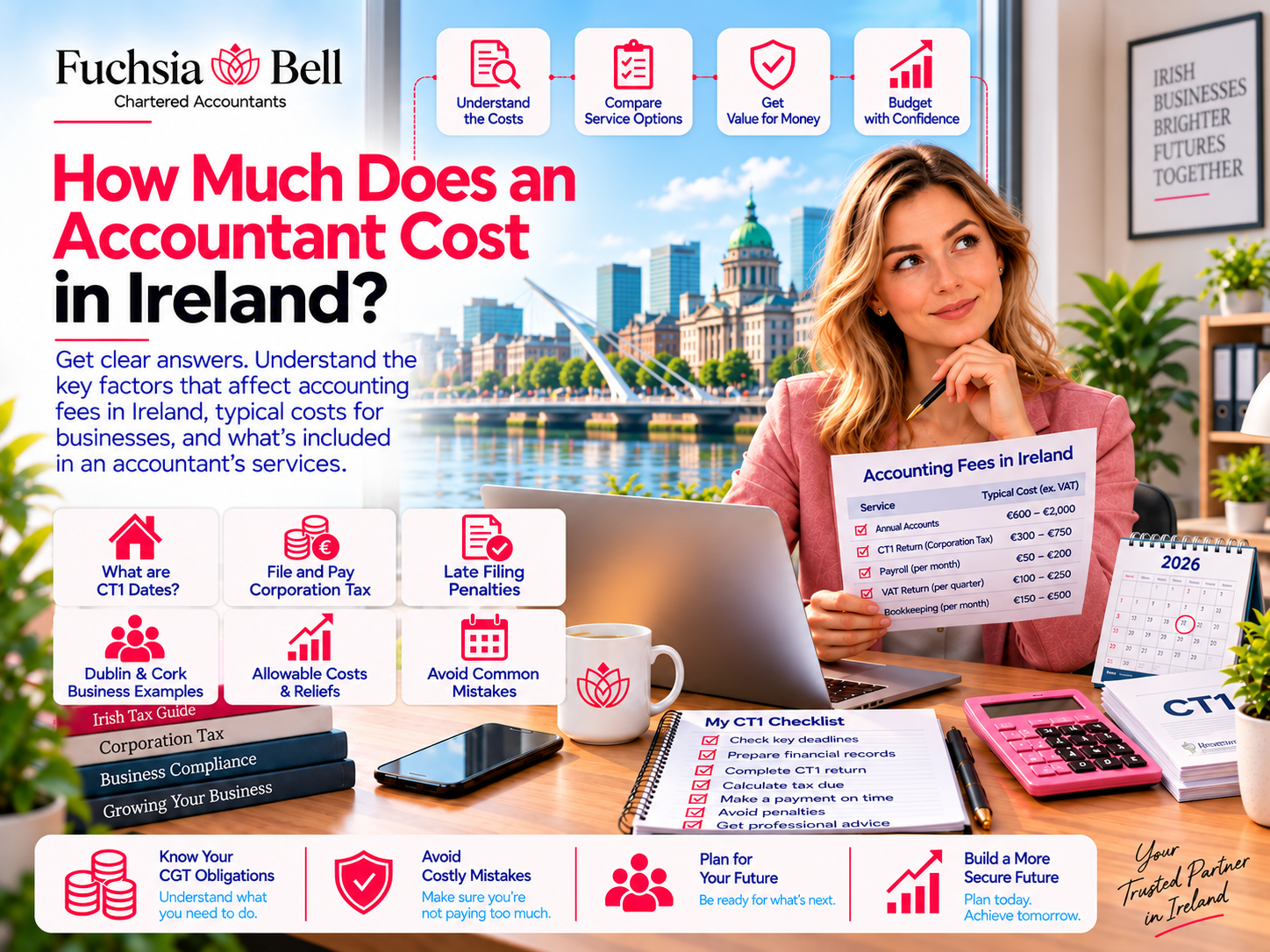
There is no single price for an accountant in Ireland, and anyone who quotes you one without asking about your business is guessing. What you pay depends on how your business is set up, how many transactions you have, how tidy your records are and which services you actually need. This guide explains what drives the fee, how Irish firms charge, which costs are not your accountant’s at all, and how to get a quote you can rely on.
The short answer
An accountant in Ireland charges according to the work involved, not a set national rate. A PAYE employee with one rental property needs far less work than a limited company with staff, VAT and a December year end. Most firms now quote a fixed fee, either monthly or annually, agreed before the work starts. The fee should be based on four things: your business structure, the volume of transactions, the condition of your records and the list of services included.
If you want a number you can budget around, the most reliable route is a written quote that sets out exactly what is covered and what is not. The rest of this guide shows you how to judge whether a quote is fair.
What you are actually paying for
An accountancy fee is really a bundle of separate jobs. Seeing them separately makes it much easier to compare quotes.
| Service | What it involves | What pushes the cost up |
|---|---|---|
| Personal tax return (Form 11) | Preparing and filing your self-assessment return on ROS, calculating preliminary tax | Rental income, foreign income, share disposals, multiple income sources |
| Sole trader accounts | Turning your income and expenses into accounts, claiming allowances, filing the Form 11 | Missing records, mixed personal and business spending, capital purchases |
| Limited company year end | Financial statements, the CT1 corporation tax return and the CRO annual return (Form B1) | Turnover, stock, number of bank accounts, director loan balances |
| Bookkeeping | Recording and reconciling every sale, purchase and bank transaction | Transaction volume, cash takings, no accounting software |
| Payroll | Running pay periods and reporting to Revenue under PAYE Modernisation | Number of employees, weekly pay runs, shift and overtime work |
| VAT returns | Preparing VAT3 returns and the annual return of trading details | Mixed VAT rates, EU trade, reverse charge, cash receipts basis |
| Advice and planning | Structuring, tax planning, cash flow, profitability reviews | Complexity and how often you need it |
A sole trader may only need the second line. A growing company may need almost all of them. That is why two quotes from the same firm can be completely different and both still be fair.
The six things that decide your fee
1. Your business structure
Sole traders file one personal return. A limited company has to prepare financial statements, file a CT1 with Revenue, file an annual return with the Companies Registration Office (CRO) and, in most cases, file a Form 11 for each director. More filings mean more work and more responsibility, so a company always costs more to look after than a sole trader with the same turnover. If you are self-employed, our page for accountants for sole traders in Ireland sets out what that service usually covers.
2. How many transactions you have
Turnover is a rough guide, but transaction volume is what really drives time. A consultant who sends ten invoices a month at €5,000 each is quicker to process than a café that takes 3,000 card payments a month at €12.
3. The condition of your records
This is the factor you control most. Bank feeds connected to cloud software, receipts captured as you go and a separate business bank account can cut the hours needed dramatically. A shoebox of receipts handed over in October costs more to sort out, every time.
4. VAT and payroll
Once you register for VAT or take on staff, you have recurring returns every few weeks or months. Each one is a deadline your accountant has to meet, so these services are usually priced per period or built into a monthly fee.
5. Catch-up work and deadlines
Overdue returns, missing years or a request to file a week before the Pay and File deadline all add cost. Starting early is cheaper than starting late.
6. Complexity and advice
Selling a property, receiving an inheritance, moving abroad or bringing in a shareholder all need specialist work that sits outside routine compliance. A good firm will tell you in advance when something falls outside your fixed fee.
How accountants in Ireland charge
You will usually meet one of four pricing models. None is wrong, but they suit different people.
| Pricing model | How it works | Best for | Watch out for |
|---|---|---|---|
| Fixed monthly fee | One agreed monthly payment covering a defined package | Businesses with ongoing bookkeeping, VAT or payroll | Check what is excluded and when the fee is reviewed |
| Fixed annual fee | One price for the year-end work, billed once or in instalments | Sole traders and simple companies | Extra charges if records arrive incomplete |
| Hourly rate | You pay for the time spent | One-off advice or unusual problems | Hard to budget, no ceiling |
| Per return | A price per filing, such as each Form 11 or VAT3 | Individuals with one or two filings a year | Advice between returns is often billed separately |
Fixed monthly fees have become the norm for online firms because they spread the cost evenly and remove the surprise invoice after year end. You can see how this works in practice on our fixed monthly accountant fees page.
Is an online accountant cheaper than a local office?
Often, but not because the work is any different. A Form 11 or a set of company accounts takes the same skill whether your accountant sits on Grafton Street or works from Tralee. The difference is overhead. A firm that runs on cloud software, secure portals and video calls does not need a city-centre reception, and that saving can be passed on.
Location also matters less than it used to. A business in Dublin can work with a chartered accountant in Kerry, and a farmer in Kerry can use a Dublin firm, without either ever visiting an office. What you should insist on, whatever the location, is a named qualified person responsible for your file and clear response times.
Costs that are not your accountant’s fee
When you budget, separate the professional fee from statutory costs and penalties. These apply whether you use an accountant or not.
- CRO annual return fee. The standard fee for filing a Form B1 electronically is €20.
- CRO late filing fees. A late annual return triggers a €100 fee, then €3 a day, up to €1,200 per return. These fees are not tax deductible.
- Loss of audit exemption. Since 16 July 2025, a small company that files its annual return late more than once in a five-year period loses its audit exemption for the following two years. An audit costs far more than routine accounts.
- Revenue late filing surcharge. A late income tax or corporation tax return adds a surcharge of 5% of the tax due (capped at €12,695) if filed within two months of the deadline, rising to 10% (capped at €63,485) after that.
- Interest on late payment. Revenue charges interest on tax paid late, separately from any surcharge.
This is the real argument against choosing on price alone. A cheaper service that misses one CRO deadline can cost a company more than a year’s difference in fees.
Is a cheap accountant a false economy?
Not necessarily. Plenty of small firms offer excellent value. The risk is not a low price, it is an unclear one. Before you sign, check the following.
- Qualification. In Ireland, anyone can call themselves an accountant. Ask which professional body they belong to, such as Chartered Accountants Ireland or ACCA.
- Professional indemnity insurance. Members of the regulated bodies who work in practice must hold it.
- A written engagement letter. It should list every service, every filing and every exclusion.
- What happens with extra work. Ask how a Revenue query, a property sale or a late document will be charged.
- Who does the work. Find out whether a qualified accountant reviews your return before it is filed.
Are accountancy fees tax deductible?
For a business, fees for preparing accounts, running payroll, keeping the books and filing the business’s tax returns are generally an allowable expense against trading profits, because they are incurred for the purposes of the trade. Fees for purely personal matters are treated differently. A PAYE employee who pays someone to file a return for personal reasons cannot usually deduct that cost.
If your accountant is VAT registered, their invoice will normally include VAT at the standard rate of 23%. A VAT-registered business can usually reclaim that VAT, which reduces the real cost of the service.
Three examples of what changes the price
These examples are illustrative. They show how scope changes, not what any particular firm charges.
Freelance designer, Dublin
Sole trader, not VAT registered, invoices through accounting software. Needs annual accounts and a Form 11. Low transaction volume and good records keep this at the simplest end of the scale.
Café company, Tralee
Limited company with six staff, weekly payroll, VAT and daily card takings. Needs bookkeeping, payroll, VAT returns, year-end accounts, the CT1 and the B1. A fixed monthly fee usually suits best.
Landlord, Killarney
PAYE employee with two rental properties. Needs a Form 11 with rental schedules and allowable expenses. Cost rises in a year when a property is sold and capital gains tax is due.
How to get an accurate quote
A firm can only give you a firm price if it understands your position. Send the following with your enquiry and you will get a far more accurate answer.
- Your business structure and the date your financial year ends.
- Your approximate annual turnover and number of monthly bank transactions.
- Whether you are registered for VAT and how many people you employ.
- The accounting software you use, if any.
- Any returns that are overdue or any open Revenue correspondence.
- Upcoming events, such as a property sale, a new shareholder or plans to incorporate.
Ask for the quote to separate routine compliance from optional extras. If your business is moving from occasional filings to monthly work, it is also worth asking how online bookkeeping services and payroll services in Ireland are priced as part of a package rather than one by one, because bundled services usually work out cheaper than paying for each separately.
What a limited company should expect to be covered
For a limited company, a complete annual service should at minimum include the financial statements, the corporation tax computation and CT1, the CRO annual return and the directors’ personal returns. If any of those are missing from a quote, ask why. Our annual accounts and CT returns service explains what that year-end package involves.
Want a fixed fee before any work starts?
Fuchsia Bell gives every client one agreed monthly fee based on the services they need. This guide was written by Ger O’Connor FCA, a Fellow Chartered Accountant who reviews every engagement personally. Start with a free 30-minute business check.
Questions About Accountant Costs
How much does an accountant cost in Ireland?
There is no fixed national rate. The fee depends on your business structure, transaction volume, the state of your records and the services you need. Most Irish firms quote a fixed monthly or annual fee after a short review of your situation.
How much does an accountant charge for a tax return in Ireland?
A simple Form 11 with one source of extra income costs much less than a return with rental schedules, foreign income or a capital gain. Ask for a fixed price per return and confirm whether preliminary tax calculations and Revenue queries are included.
Do accountants in Ireland charge monthly?
Many do. Fixed monthly fees are common for businesses that need bookkeeping, VAT or payroll during the year. Sole traders and individuals with only a year-end return often pay a single annual fee instead.
Is an online accountant cheaper?
Online firms often have lower overheads than city-centre offices, which can mean lower fees for the same work. The qualification and regulation of the accountant matter more than whether you meet in person.
Can I file my own returns without an accountant?
Yes. Individuals can file a Form 11 on ROS and companies can file their own CT1 and B1. The risk lies in missed deadlines, unclaimed reliefs and penalties, which can quickly cost more than professional fees.
Are accountant fees tax deductible in Ireland?
Fees incurred for running your business, such as preparing accounts and filing the business’s tax returns, are generally deductible against trading profits. Purely personal tax work is generally not deductible.
Figures checked against Revenue and Companies Registration Office guidance in November 2026. Rates and thresholds can change, so confirm current figures before you rely on them.