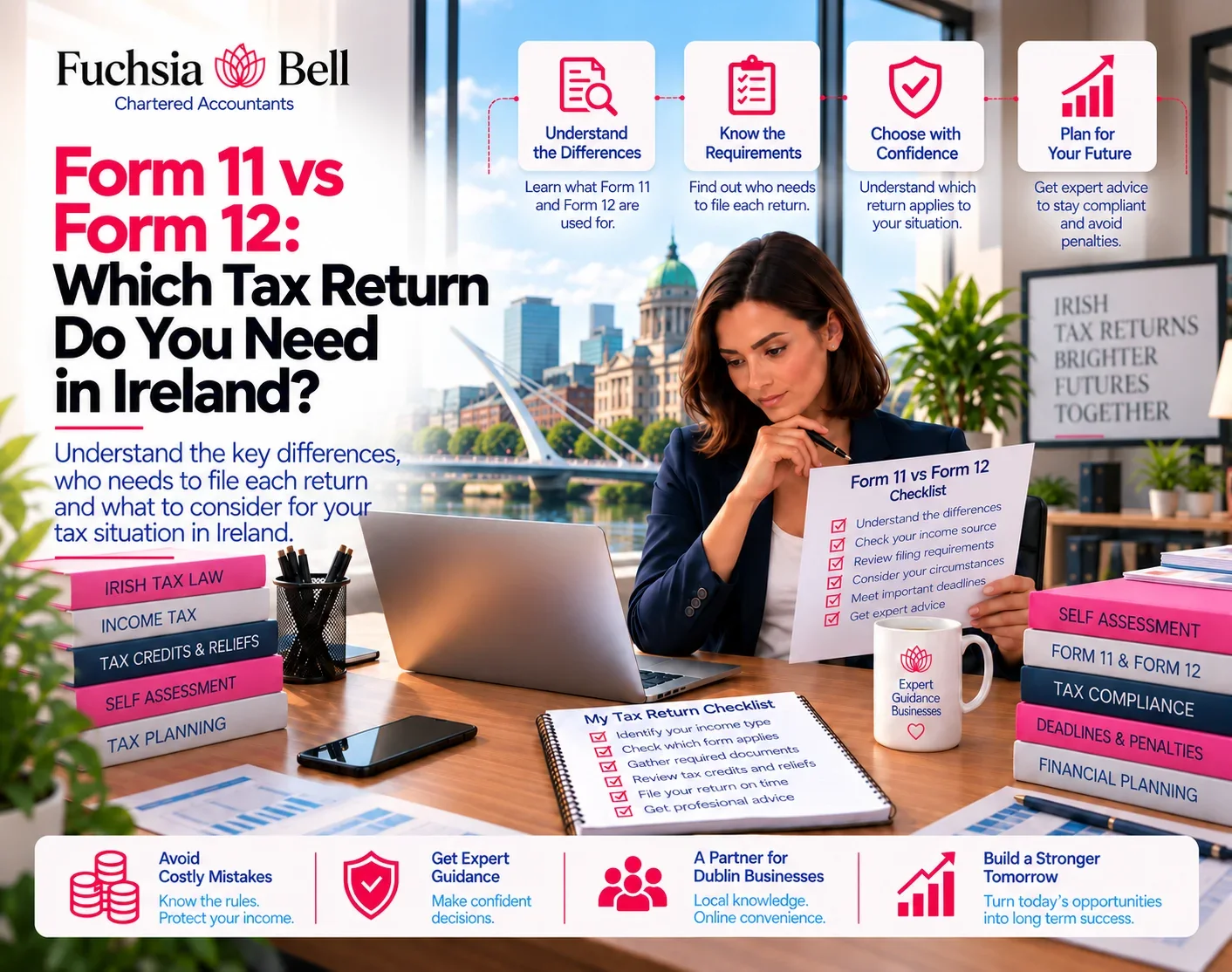
The 31 October deadline is close and you are not sure whether your return is a Form 11 or a Form 12. It comes down to one question: are you a chargeable person who files a full self-assessment return, or a PAYE employee with a claim to make or a small amount of extra income? This Form 11 vs Form 12 guide covers who files which, where each one goes, the 2026 dates and what happens if you pick the wrong one.
Key takeaways
- Form 11 is the full self-assessment return, filed on ROS by chargeable persons such as sole traders, landlords and proprietary company directors.
- Form 12 is the shorter return for PAYE employees, filed in myAccount, usually to claim credits or reliefs or to declare small extra income.
- You generally file a Form 11 if your non-PAYE income is over €5,000 after expenses, or over €30,000 before expenses.
- The Pay and File date for your 2025 return is 31 October 2026, extended to 18 November 2026 if you pay and file through ROS.
- Filing late costs a 5% surcharge (capped at €12,695) or 10% (capped at €63,485), plus interest on tax paid late.
What is the difference between Form 11 and Form 12?
Form 11 is the full self-assessment income tax return for chargeable persons, filed through ROS. Form 12 is the shorter return for PAYE employees without significant extra income, filed through myAccount, mainly to claim credits and reliefs or declare small amounts of other income. Revenue’s income tests and director rules decide which applies.
| Form 11 | Form 12 | |
|---|---|---|
| Who files it | Chargeable persons: self-employed, landlords, proprietary directors | PAYE employees who are not chargeable persons |
| Where it is filed | ROS | myAccount |
| Typical use | Full self-assessment of income, gains and reliefs | Claiming credits or reliefs, or declaring small extra income |
Getting the form right matters because the wrong one wastes weeks. Preparing an income tax return usually starts with listing every source of income for 2025, PAYE and non-PAYE, before you decide which form fits.
Who has to file a Form 11 in Ireland?
You file a Form 11 if you are a chargeable person. Under Revenue’s rules that means non-PAYE income over €5,000 after expenses, gross non-PAYE income over €30,000, or being a proprietary director, which means holding more than 15% of a company’s ordinary share capital. Once chargeable, you stay chargeable while that income continues.
In practice that covers:
- Sole traders and the self-employed with trading profits.
- Landlords whose rental profit is over €5,000 after allowable expenses. A Dublin landlord with €6,000 of rental profit after expenses is over the line.
- Proprietary directors, even if their only income is a PAYE salary from their own company.
- Anyone with non-PAYE income above the limits, such as an employee with a side business.
The 15% director test is the one that surprises people. A Dublin director paying themselves a salary through payroll still files a Form 11 with Revenue, because the PAYE-only exception generally does not apply to directors.
Who files a Form 12 instead?
You file a Form 12 if you are a PAYE employee who is not a chargeable person. Typical reasons are claiming credits or reliefs your payslip did not pick up, declaring a small amount of extra income below the Form 11 limits, or fixing your tax record. You file it through myAccount, not ROS.
A Dublin employee with €2,000 of freelance income on top of a PAYE job is usually under the €5,000 line, so a Form 12 can cover it. If you move from PAYE into self-employment, you cross into Form 11 territory, and our guide to the self-assessment tax return explains what changes.
When is the Form 11 deadline for 2025?
The Pay and File deadline for your 2025 Form 11 is Saturday 31 October 2026. If you both file and pay through ROS, Revenue extends it to Wednesday 18 November 2026. You also pay any 2025 balance and your 2026 preliminary tax by that same date.
| Item | Date or amount |
|---|---|
| Standard Pay and File deadline | 31 October 2026 |
| Extended date if you file and pay on ROS | 18 November 2026 |
| Surcharge if filed less than two months late | 5% of tax due, maximum €12,695 |
| Surcharge if filed more than two months late | 10% of tax due, maximum €63,485 |
According to Revenue’s Pay and File guidance, the extension only applies when both the filing and the payment go through ROS. In short: file and pay on ROS by 18 November 2026, or by 31 October 2026 if you cannot do both there.
Does a CG1 count as a Form 11?
No. A CG1 is a separate Capital Gains Tax return for disposals in a set period, while the Form 11 is your annual income tax return. If you sold an asset between 1 January and 30 November 2026, the CGT is due by 15 December 2026, whatever your Form 11 status.
If that applies to you, the steps for the CG1 form are in our separate guide, and the two returns should tell the same story about any gain.
What happens if you file the wrong form?
Revenue will normally ask for the correct return, and the late filing rules still apply if the right one arrives after the deadline. Late filing costs a 5% surcharge capped at €12,695 within two months, then 10% capped at €63,485. Interest on late tax runs at 0.0219% a day.
The good news is that a wrong form is easy to fix if you act early. Interest at 0.0219% a day means €2,000 paid 60 days late costs about €26. Handing the paperwork to someone who files tax returns every week takes the guesswork out of it.
Getting help with your tax return in Dublin, Galway and across Ireland
Fuchsia Bell is a firm of chartered accountants in Castlemaine, Co. Kerry, run by Gero O’Connor, working with clients all over Ireland online. That includes self-employed people, landlords and directors in Dublin, where our tax services in Dublin cover both forms. If you are in the west, a chartered accountant in Galway can look after your return fully online. We also work with clients in Mayo and right across Ireland.
Frequently Asked Questions
Is Form 11 the same as self-assessment?
Yes. Form 11 is the income tax return you use to self-assess your tax in Ireland. You file it through ROS, and it brings together your income, gains, expenses and reliefs for the year. PAYE employees who are not chargeable persons usually file a Form 12 instead.
Can I file a Form 11 in myAccount?
No. A Form 11 is filed through ROS, Revenue’s online service for self-assessment, where you can also pay your balance and preliminary tax. A Form 12 is filed through myAccount. You need to file and pay through ROS to get the extended 18 November 2026 date.
Does a PAYE employee ever need to file a Form 11?
Yes. A PAYE employee becomes a chargeable person if they have non-PAYE income over €5,000 after expenses, gross non-PAYE income over €30,000, or they are a proprietary director holding more than 15% of a company’s ordinary share capital. Once chargeable, they stay chargeable while that income continues.
What is the Form 11 deadline for 2025 income?
The deadline is 31 October 2026, or Wednesday 18 November 2026 if you file and pay through ROS. Your 2026 preliminary tax is due on the same date, so it makes sense to deal with both together and avoid a second trip into ROS.
How much is the surcharge for filing a Form 11 late?
It is 5% of the tax due, capped at €12,695, if you file less than two months late. After two months it rises to 10%, capped at €63,485. Interest on any tax paid late runs at 0.0219% a day on top of that.
If your situation is a bit messier than the examples above, talking it through with a chartered accountant can usually sort it out in one conversation. We can look at your 2025 income, tell you which return applies and what you will owe, and get it filed before the date that matters.