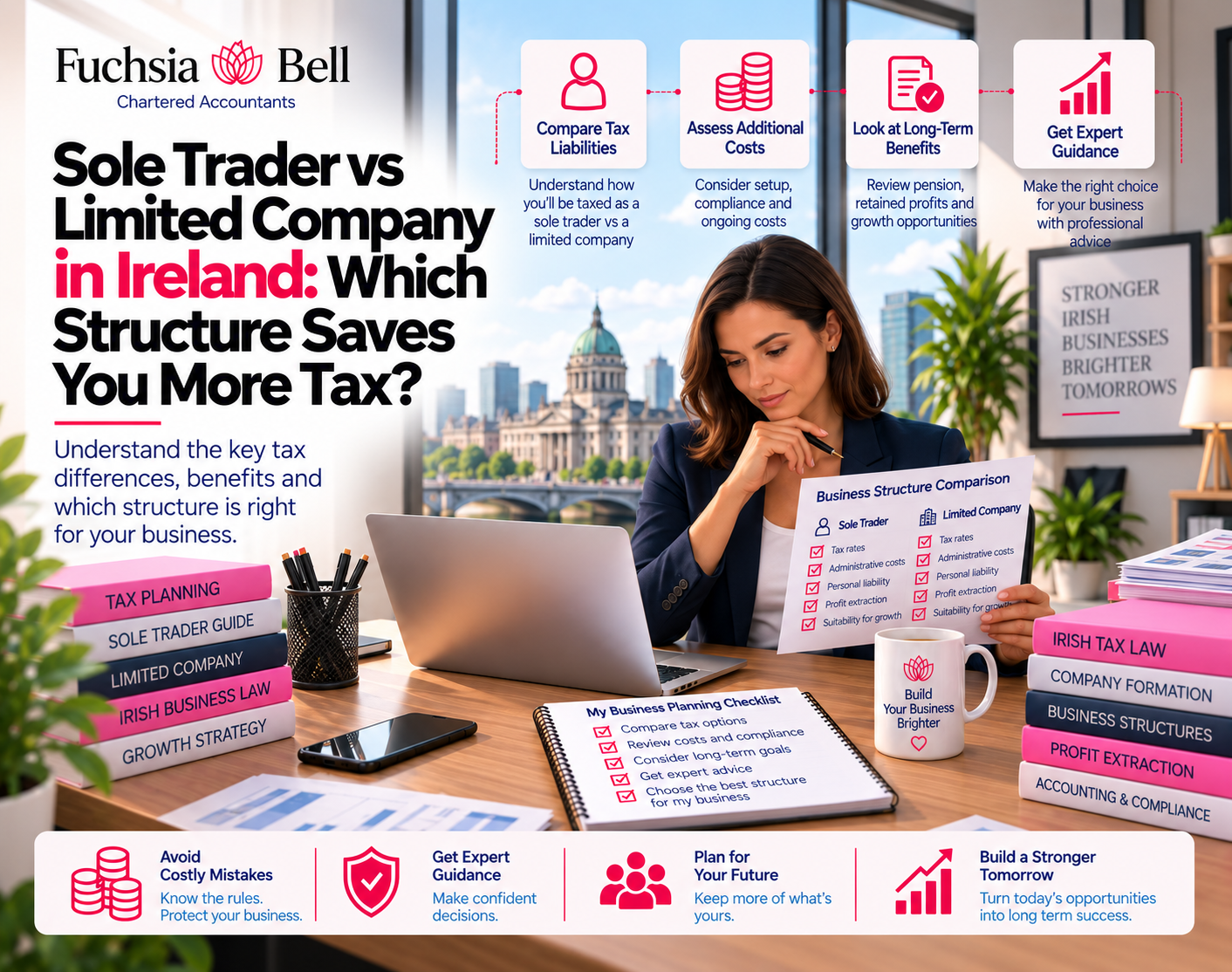
Most people frame this as a paperwork question. It is actually a tax question, and the answer changes significantly once your profits move past a certain point. The structure that saves the most tax for a consultant earning €60,000 a year is different from the one that makes sense for a business planning to retain €200,000 in profits over three years.
How Each Structure Is Taxed
As a sole trader, every euro of profit is your personal income. It runs straight through income tax, USC, and PRSI, with no separation between what the business earns and what you take home. On profits above €40,000, the combined rate moves well past 50%.
A limited company pays 12.5% on trading profits. That rate only benefits you if the money stays in the company. Extracting profits as salary brings them back into personal income tax rates immediately.
The Point Where a Company Starts to Win
| Annual Net Profit | Sole Trader Tax (approx) | Company (retained) Tax (approx) |
|---|---|---|
| €30,000 | ~€7,500 | ~€3,750 + higher admin costs |
| €60,000 | ~€24,000 | ~€7,500 on retained element |
| €100,000+ | ~€46,000+ | Significantly lower if retained |
The break-even point is generally in the €40,000 to €60,000 net profit range, once company formation and annual accountancy costs are factored in. The 12.5% corporation tax rate only beats personal rates when profits are retained inside the company, not when they are extracted the same year they are earned.
The Director Salary Problem
Taking money out of a company means paying yourself a salary, taking dividends, or a combination of both. A salary is subject to PAYE, USC, and PRSI exactly as any other employment income. The planning opportunity is in structuring how and when you extract money, not simply in setting up the company. Filing an income tax return each year remains an obligation for any director receiving income outside PAYE.
Pension Contributions Change the Numbers
A limited company can make employer pension contributions on behalf of company directors without those contributions being treated as salary. They reduce the company’s taxable profit at 12.5%, and the director receives them without income tax at the point of contribution. Running the comparison without factoring in pension contributions often understates how much a company saves for a director with a long career horizon.
What Sole Traders Keep That Directors Give Up
A sole trader can offset trading losses directly against other income, including a spouse’s income in some cases. There are no annual Companies Registration Office obligations, no requirement to file annual company accounts, and no risk of Revenue applying a close company surcharge on undistributed professional service income. Maintaining clean bookkeeping records matters for both structures, but the filing obligations are considerably lighter for a sole trader.
The Close Company Surcharge
Professional service companies, those operated by accountants, doctors, solicitors, or consultants, face an additional 15% surcharge from Revenue on undistributed income from professional activities. This catches directors who assume all retained profits automatically sit at the 12.5% rate. The surcharge narrows the gap considerably for professional service businesses that have no legitimate operational reason to retain profits.
Capital Gains and Business Exits
If the plan ever includes selling the business, the structure matters at exit. The Entrepreneurial Relief scheme reduces CGT to 10% on qualifying disposals of business assets, up to a lifetime limit of €1,000,000. This applies to shareholdings in qualifying trading companies and to sole-trader business assets. Which route gives a cleaner exit depends on the nature of the business and how long assets have been held.
Questions About Sole Trader vs Limited Company Tax
Can I switch from a sole trader to a limited company later without tax consequences?
Yes. Incorporating a sole trader business is possible at any stage. The transfer of business assets can often be done on a tax-neutral basis, but the mechanics need to be planned in advance, particularly for assets that have gained value since purchase.
Does a limited company protect me personally from tax debts the company owes?
Separate legal personality protects personal assets in most commercial situations, but directors can be made personally liable for PAYE, VAT, and PRSI the company failed to pay if they were knowingly involved in the non-payment.
Do I pay myself a salary or dividends from my company?
Both are common. A combination approach, taking a salary up to a tax-efficient level and drawing the rest as dividends, is widely used. The right split depends on marginal tax rate, USC thresholds, and pension planning.
Is the 12.5% corporation tax rate guaranteed for the long term?
The rate is set by legislation and has been stable for decades, but no tax rate is permanent. The OECD global minimum tax rules mean some large companies now face a 15% rate, though most Irish SMEs are not affected.
Does a limited company still make sense if I work through a single client?
Revenue has specific guidance on managed service companies and intermediary arrangements. If the majority of your work flows through one client, the section 18 contractor rules may limit the tax advantage of using a company structure.
What are the ongoing costs of running a limited company?
Annual CRO filing fees, preparation of company accounts (which must follow a statutory format), and increased accountancy fees compared to sole-trader accounts. For most small companies, the additional compliance cost runs between €1,500 and €3,000 annually.
Can a limited company carry forward losses to future years?
Yes. Trading losses can be carried forward against future trading profits of the same company indefinitely, or carried back one year against prior profits in some circumstances.
If I close the company, how are accumulated retained profits taxed?
Profits distributed on a formal liquidation may qualify for capital gains treatment rather than income tax, depending on how the wind-up is structured. This can reduce the effective rate on profits retained over several years of trading.
Working Out Which Structure Fits Your Position
The tax difference between structures widens as profits grow and narrows when extraction costs and compliance overhead are counted. Running the actual numbers for your current position, your expected trajectory, and any exit plan is worth the accountancy fee before making a decision that is difficult to unwind.
How We Help Kerry and National Clients Get This Right
We work through the sole trader and limited company question regularly, particularly for clients approaching the point where retained profits start to represent a genuine saving. Our analysis covers the extraction plan, pension strategy, and close company exposure, not just the headline corporation tax rate. For clients looking for a broader view of Irish business structures, the team at geroconnor.info covers the company secretarial requirements that come with incorporation.