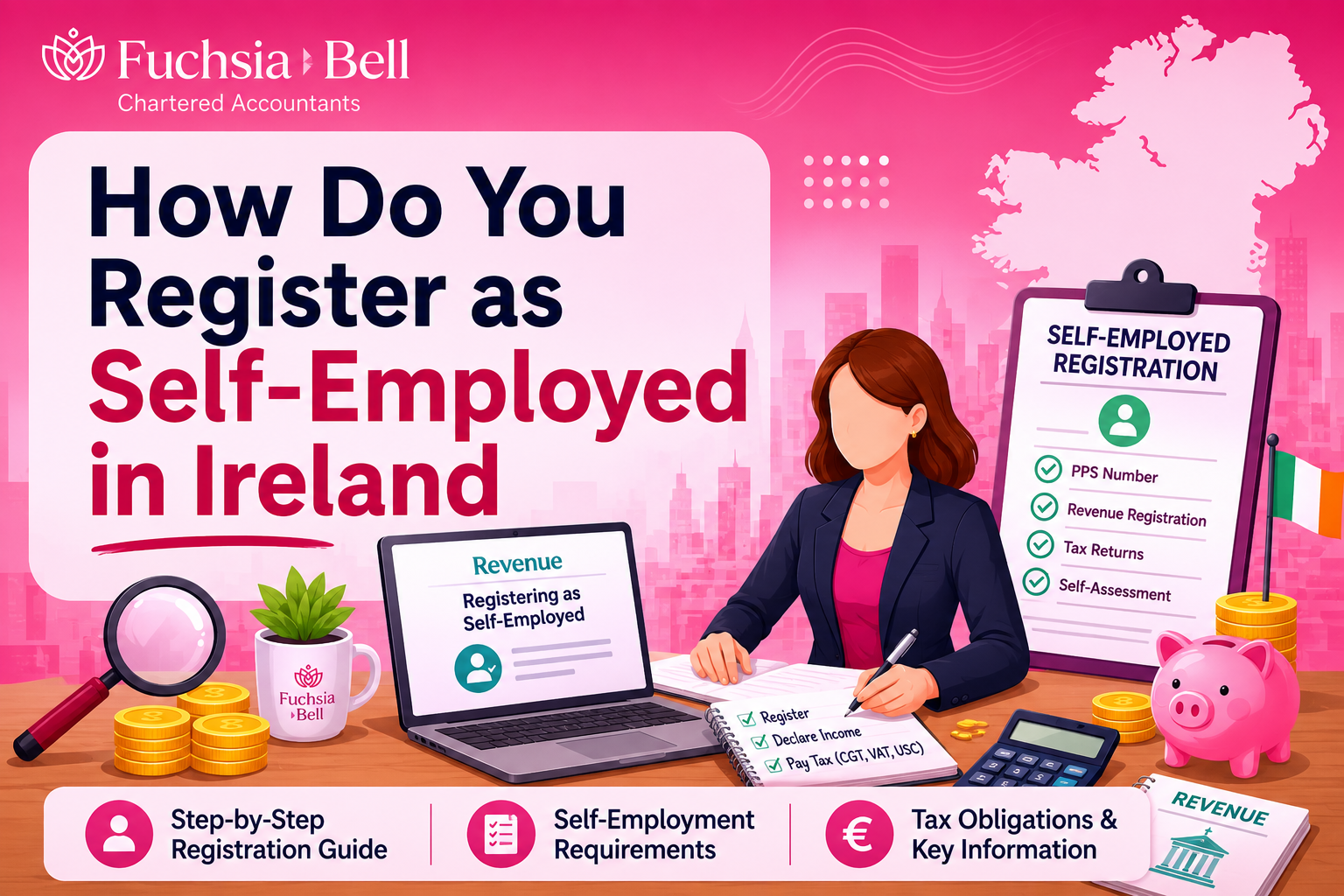
Going self-employed is one of the biggest financial decisions you’ll make and the admin side can feel overwhelming if nobody has walked you through it before. This guide covers every step you need to take, from getting your finances in order before you start trading, all the way through to understanding your ongoing tax obligations once you’re up and running.
Whether you’re a freelancer, sole trader, or contractor, here’s exactly how to do it correctly with Revenue.
How Should You Prepare Before Becoming Self-Employed in Ireland?
Before you register with Revenue, it’s worth pausing to make sure you’re actually ready — financially and practically. Going self-employed without preparation is one of the most common reasons people run into cash flow problems in their first year.
How much savings should you have before going self-employed?
A general rule is to have at least three to six months of personal living expenses set aside before you leave employment. This acts as a buffer while your income stabilises. On top of that, remember you’ll owe Preliminary Tax to Revenue — typically 90% of your current year’s liability — so you need to factor tax bills into your cash reserves from day one.
How do you test whether there is real demand for your idea?
Before committing fully, validate your service or product. Talk to potential clients, take on a few small contracts on the side while still employed (Revenue allows this — see our guide on taxes for individuals with additional income), and see whether you can generate income before you walk away from your salary.
What are the main financial risks of becoming self-employed?
The biggest risks are irregular income, unexpected tax bills, and the absence of employer PRSI contributions toward your state pension. Unlike PAYE employees, self-employed people pay Class S PRSI, which gives you a narrower range of social welfare entitlements. Building a tax reserve of roughly 30–40% of every invoice you raise will protect you from a shock come October each year.
What Is the Difference Between a Sole Trader and a Limited Company in Ireland?
The structure you choose affects everything: how much tax you pay, your personal liability, your admin burden, and how you’re perceived by clients and banks.
What are the main advantages of being a sole trader?
A sole trader is the simplest and cheapest structure. There’s no Companies Registration Office (CRO) involvement, no requirement to file annual accounts publicly, and minimal compliance overhead. You pay income tax on profits through self-assessment, and you can get up and running within days of registering with Revenue.
When should you consider setting up a limited company instead?
A limited company makes more sense once your profits rise consistently above around €50,000–€60,000 per year, when you want to limit personal liability, or when a corporate client specifically requires you to invoice through a company. Corporation Tax in Ireland sits at 12.5% on trading profits — significantly lower than the higher personal income tax rate of 40%. However, extracting money from the company as a director’s salary or dividend creates its own tax obligations.
For a full breakdown of the pros, costs, and tax implications of each option, read our dedicated guide on sole trader vs limited company in Ireland.
How Do You Register as Self-Employed with Revenue in Ireland?
This is the step most people search for, and it’s straightforward once you know which route to take. You need to register for income tax with Revenue — this is separate from registering a business name with the CRO.
How do you register online using myAccount or eRegistration?
The quickest route is through Revenue’s myAccount portal. Once logged in, go to Manage My Record → Register for New Taxes. You’ll see an option to register for income tax as a self-employed individual. This is free, takes around 10–15 minutes, and is processed within a few working days.
How do you register using the paper TR1 form?
If you can’t use myAccount for example, because you don’t yet have an Irish PPSN set up — you can download and complete the TR1 form (Tax Registration 1) from Revenue’s website and post it to your local Revenue office. This takes longer, usually one to two weeks.
What is the TR1(FT) form and who needs to use it?
The TR1(FT) is the version of the TR1 for non-resident individuals who are registering for Irish tax for the first time. If you’ve recently moved to Ireland or are a foreign national without a myAccount profile, this is the correct form to use.
How do you register using ROS?
If you already have a Revenue Online Service (ROS) account — for example, if you’ve previously filed as a sole trader — you can register for additional taxes or update your tax registrations directly through ROS. For most first-time registrations, myAccount is the easier starting point.
When and how do you receive your Tax Registration Number?
Once your registration is processed, Revenue will issue your Tax Registration Number (TRN) — this is the same as your PPSN. You’ll receive a confirmation letter or notification through your myAccount inbox confirming you’re registered for income tax under self-assessment.
Do you need a separate business bank account when self-employed?
As a sole trader, you are not legally required to have a separate business bank account — but it is very strongly recommended. Keeping business and personal finances separate makes bookkeeping far simpler, and your accountant will thank you for it. Banks such as AIB, Bank of Ireland, and a number of challenger banks offer business current accounts specifically for sole traders.
Do You Need to Register a Business Name as a Sole Trader in Ireland?
If you trade under your own full legal name (e.g., “Aoife Murphy” providing consulting services), you do not need to register a business name. However, if you trade under any other name — such as “Murphy Marketing” or “AM Design Studio” — you are legally required to register that name with the Companies Registration Office (CRO).
What is the RBN1 form and how do you complete it?
The RBN1 form (Registration of Business Name — Individual) is the form you submit to the CRO to register a business name as a sole trader. It requires your full name, address, business name, and nature of the business. You can submit it online via core.ie (the CRO’s online portal) or by post.
How much does it cost to register a business name with the CRO?
As of 2025, the fee for online registration is €20, and for paper submission it is €40. Online is faster and cheaper — most applications are processed within two to three working days.
What is the deadline for registering a business name?
You must register within one month of first using the business name. There’s no grace period and using an unregistered business name is an offence under the Registration of Business Names Act 1963.
How Do You Pay Income Tax as a Self-Employed Person in Ireland?
Once you’re registered as self-employed, you move out of the PAYE system and into self-assessment. This is the part that trips most people up if they haven’t been told what to expect.
What is Form 11 and when do you need to complete it?
Form 11 is the annual income tax return form for self-employed individuals in Ireland. You must file it with Revenue each year for the previous tax year. The deadline for online filing through ROS is typically 31 October, extended to mid-November when you both file and pay through ROS. Our guide on how to do your self-assessment tax return in Ireland walks through the Form 11 step by step.
Who needs to register for income tax self-assessment?
Anyone whose non-PAYE income exceeds €5,000 in a tax year must register for self-assessment. This includes sole traders, company directors, landlords, and people with investment income. If your non-PAYE income is less than €5,000, you may be able to declare it through the simpler Form 12 as a PAYE worker.
What income tax rates apply to self-employed people in Ireland?
Self-employed people in Ireland pay income tax at the same rates as PAYE employees:
- 20% on income up to €42,000 (single person, 2025)
- 40% on income above that threshold
On top of income tax, you also pay USC (Universal Social Charge) and PRSI. Use our income tax calculator for Ireland to get a reliable estimate of your total liability before you file.
What is Preliminary Tax and how is it calculated?
Preliminary Tax is an advance payment of the current year’s tax liability, paid on or before 31 October each year. You must pay at least whichever is the smallest of:
- 90% of the current year’s final liability, or
- 100% of the prior year’s final liability.
Most accountants recommend paying 100% of the prior year’s liability as it avoids an underpayment surcharge and removes any guesswork.
For a complete picture of what self-employed people can deduct to reduce their tax bill, see our guide on self-employed tax deductions in Ireland.
What PRSI and VAT Obligations Do Self-Employed People Have in Ireland?
Tax doesn’t stop at income tax. As a self-employed person, you also need to understand your PRSI class and whether you need to register for VAT.
What PRSI class do self-employed people pay (Class S)?
Self-employed people in Ireland pay Class S PRSI at a rate of 4% on all income above €5,000 per year, with a minimum annual contribution of €500. Class S provides entitlement to certain contributory payments — including the State Pension (Contributory) and Maternity Benefit — but does not cover Jobseeker’s Benefit or Illness Benefit in the same way that Class A (employee) PRSI does.
At what turnover threshold must you register for VAT in Ireland?
You are legally required to register for VAT once your annual turnover reaches:
- €40,000 for services
- €80,000 for goods (supply of goods)
You can also register voluntarily below these thresholds, which can be advantageous if your clients are VAT-registered businesses and you want to reclaim VAT on your costs. Read our full explainer on how to register for VAT in Ireland if you’re approaching either threshold.
What VAT rate applies to your type of business?
The standard Irish VAT rate is 23%, which applies to most goods and services. A reduced rate of 13.5% applies to certain supplies including construction services, fuel, and some hospitality. Professional services such as legal, accountancy, and financial advice are generally exempt from VAT. If you’re unsure which rate applies to your business, this is something an accountant can clarify quickly.
Can You Be Both Employed and Self-Employed at the Same Time in Ireland?
Yes — and it’s more common than most people think. Many people build a side business while still in employment before going fully self-employed. Revenue fully accommodates this arrangement, but you do need to manage your tax carefully.
What are the tax implications of being employed and self-employed at the same time?
Your PAYE employment income continues to be taxed through payroll as normal. Your self-employment income sits on top of this and is taxed through self-assessment at the end of the year. Critically, because your tax credits and standard rate band are already being used by your employer, your self-employment profits are likely to be taxed entirely at the higher 40% rate from the first euro of profit — so you need to set aside a higher proportion of your self-employment earnings for tax.
Our guide on taxes for individuals with additional income covers the exact mechanics of how Revenue calculates your combined liability.
Do you still make PRSI contributions if you are also a PAYE employee?
Yes. If you earn more than €5,000 from self-employment in addition to your PAYE income, you pay both Class A PRSI (through your employer) and Class S PRSI on your self-employment profits. There is no double-counting — each applies to its relevant income stream. Your entitlements are based on the more favourable class, so in most cases your Class A contributions protect your access to Illness Benefit and Jobseeker’s Benefit.
Need Help Getting Registered and Staying Compliant?
Registering as self-employed is straightforward, but managing your taxes correctly once you’re up and running is where most people benefit from professional support. From filing your self-assessment tax return correctly the first time to making sure you’re claiming every allowable deduction, getting it right from the start avoids costly mistakes down the line.
At Fuchsia Bell, we work with sole traders, freelancers, and self-employed professionals across Ireland — all online, without the need for in-person meetings. Get in touch for a free quote and we’ll assess your situation and let you know exactly what you need.