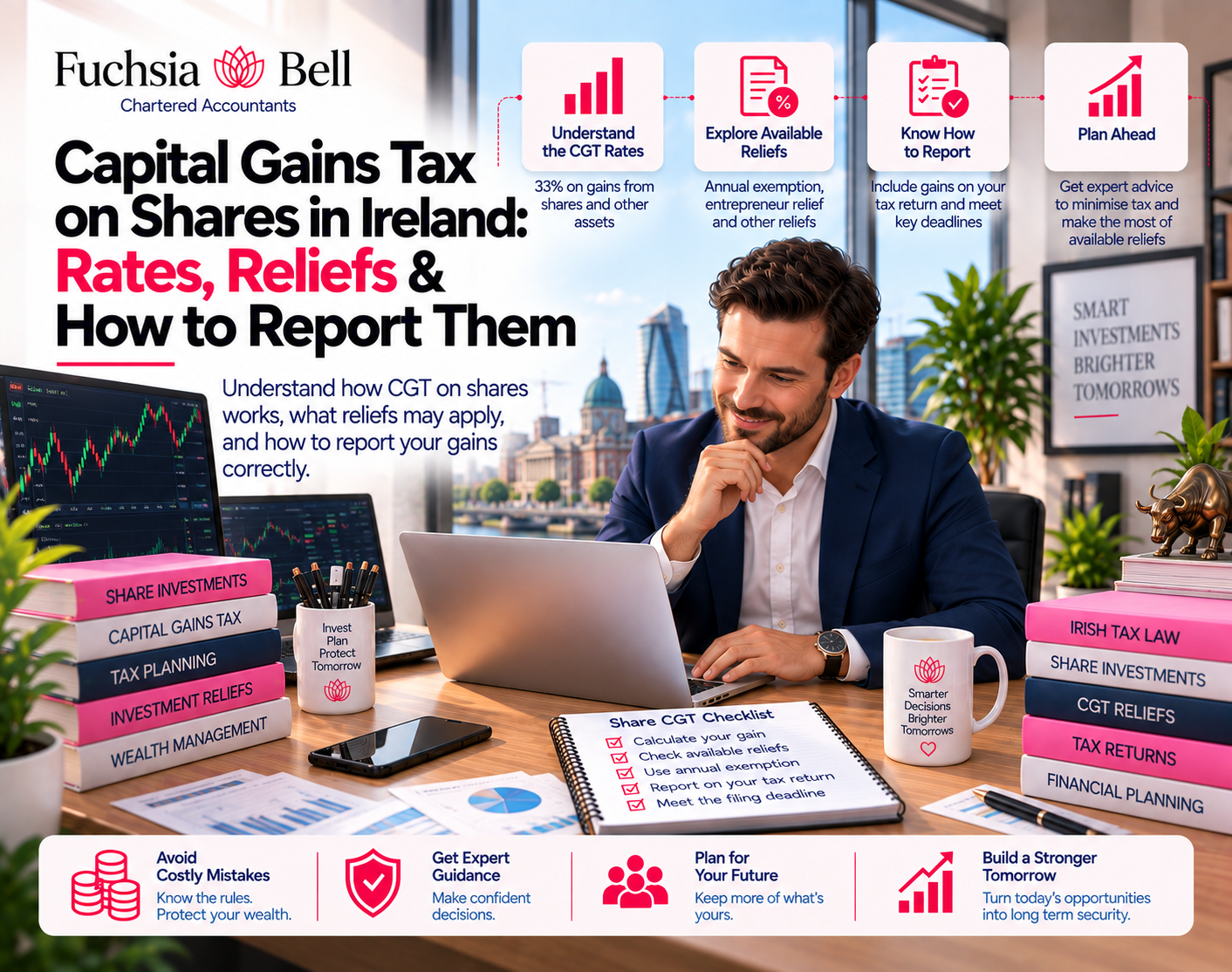
Most of the CGT conversation in Ireland centres on property. Shares are treated as chargeable assets in exactly the same way, at the same 33% rate, but the rules around cost basis, share matching, and the reliefs available work differently. Whether you hold quoted shares through a broker, own shares in a private company, or received shares through an employment scheme, a disposal creates a CGT event and the figures on the return have to be right.
How CGT on Shares Is Calculated
The gain is sale proceeds minus the acquisition cost and any incidental costs directly connected to the disposal or purchase. The net gain is reduced by the annual CGT exemption of €1,270, and the remaining balance is taxable at 33%. If the shares produced a loss rather than a gain, that loss offsets other capital gains in the same tax year or carries forward indefinitely against future gains. Revenue treats a disposal as occurring on the date of the contract, not the settlement date.
What Costs Can You Actually Deduct?
Revenue allows the purchase price, stamp duty paid at the time of acquisition (1% on Irish shares), broker commissions on both the purchase and the sale, and any costs directly incurred to acquire or dispose of the shares. For private company shares, subscription costs, legal fees, and valuation costs on unlisted shares are allowable where genuinely incurred. Reliable bookkeeping records of every share purchase, with original dates, amounts, and associated costs, are what make these deductions clean to claim at disposal time.
The Share Matching Rules Revenue Uses
When shares in the same company were bought at different times and prices, Revenue uses specific matching rules to determine which shares were sold and at what cost. Shares acquired on the same day as the disposal are matched first. Shares acquired within 30 days after the disposal are matched next, which blocks the practice of selling at a loss and immediately buying back to manufacture a deductible loss. After those two pools, remaining shares match on a first in, first out basis using the oldest purchase price first.
What Reliefs Are Available on a Share Disposal?
Entrepreneur Relief under Section 597AA provides a reduced rate of 10% on qualifying gains from disposing of shares in a trading company, where the individual held at least 5% for three continuous years and worked as a director or employee. The lifetime limit is €1 million of qualifying gains. Retirement Relief applies to individuals aged 55 or over disposing of shares in a family trading company. Both reliefs must be in place before the disposal, not after. The full list of CGT exemptions and applicable thresholds applies on top of both.
Does the 7-Year CGT Exemption Still Apply to Shares?
Section 604A of the TCA 1997 provided full relief on the gain attributable to a 7-year holding period for assets, including shares, acquired between 7 December 2011 and 31 December 2014. The scheme is closed to new purchases and the original 7-year windows have all now expired. Anyone who bought shares in that period and is still holding them should understand how the capital gains tax position works on a future disposal before they sell, particularly where shares have continued to rise in value after the 7-year period closed.
What Happens When You Inherit Shares?
An inheritance is not a disposal and no CGT arises when shares pass on death. The person inheriting takes on a cost base equal to the market value of the shares at the date of death, not what the original owner paid. CGT is calculated on the gain from that inherited value when the shares are eventually sold. Capital Acquisitions Tax may also apply to the inheritance itself, and where both CGT and CAT arise on the same shares Revenue provides a credit to reduce double taxation.
When and How Do You Report and Pay?
Gains made between 1 January and 30 November must be paid by 15 December of the same year. Gains made in December must be paid by 31 January of the following year. Missing the CGT payment dates triggers interest at 0.0219% per day, which accumulates quickly on a large gain. The return itself is filed through the annual income tax return for self-assessed individuals, or via Form CG1 for PAYE workers who have no other requirement to file a return.
Can Share Losses Be Offset Against Other Gains?
Capital losses on shares offset capital gains on any chargeable asset in the same year, not just gains on other shares. If losses exceed gains in a year, the net loss carries forward indefinitely against future gains on any asset. Losses cannot be carried back to a prior tax year. Losses on shares in an unquoted company owned by a connected person can only be set against gains from disposals to that same connected person, not used as a general capital loss.
Frequently Asked Questions
Do you pay CGT when you exercise share options?
No. Exercising a share option typically triggers income tax, USC, and PRSI at exercise. CGT only arises on a subsequent disposal of the shares, calculated from the market value at the date of exercise.
Are dividends subject to CGT?
No. Dividends are income, not capital. They are subject to income tax, USC, and PRSI. CGT applies only to the gain on disposal of the shares themselves.
What rate applies to shares in a foreign company?
The standard 33% CGT rate applies. If the gain was subject to tax in another country, Ireland’s double taxation agreements may allow a credit against the Irish CGT liability.
Do you pay CGT on shares inside a pension?
No. Shares held within a Revenue-approved pension fund grow free of CGT. The tax position arises when benefits are drawn from the pension, not while inside the fund.
We Handle Share Disposals and CGT Returns Every Year
Getting the share matching right, identifying which reliefs apply, and hitting the correct payment deadlines are where CGT return mistakes happen most often. At Fuchsia Bell we work through share disposals for clients across the country, from straightforward quoted share sales to complex situations involving private company shares, inherited holdings, and employment scheme disposals. For the business side of any disposal, tax advisory support from GEroConnor covers that ground alongside us.
Talk to Us Before the December Deadline
The December payment date catches people out every year. If you have sold shares at any point during the year, the liability may already be building and the window to plan around it is short. Our tax returns service covers CGT alongside all other filing obligations. For how share disposals interact with business asset positions, CGT guides on GEroConnor’s site cover the wider picture.